Experience
Peterborough Cathedral — The Ceiling Everyone Walks Under
People come to Peterborough Cathedral for two queens, one who is still here and one who was taken away. The thing most of them should be looking at is above their heads, and it has been hanging above the nave, through restoration and alteration, for roughly eight centuries.
By James B. Stoney, Editor · 22 September 2026
Fire, Then Stone
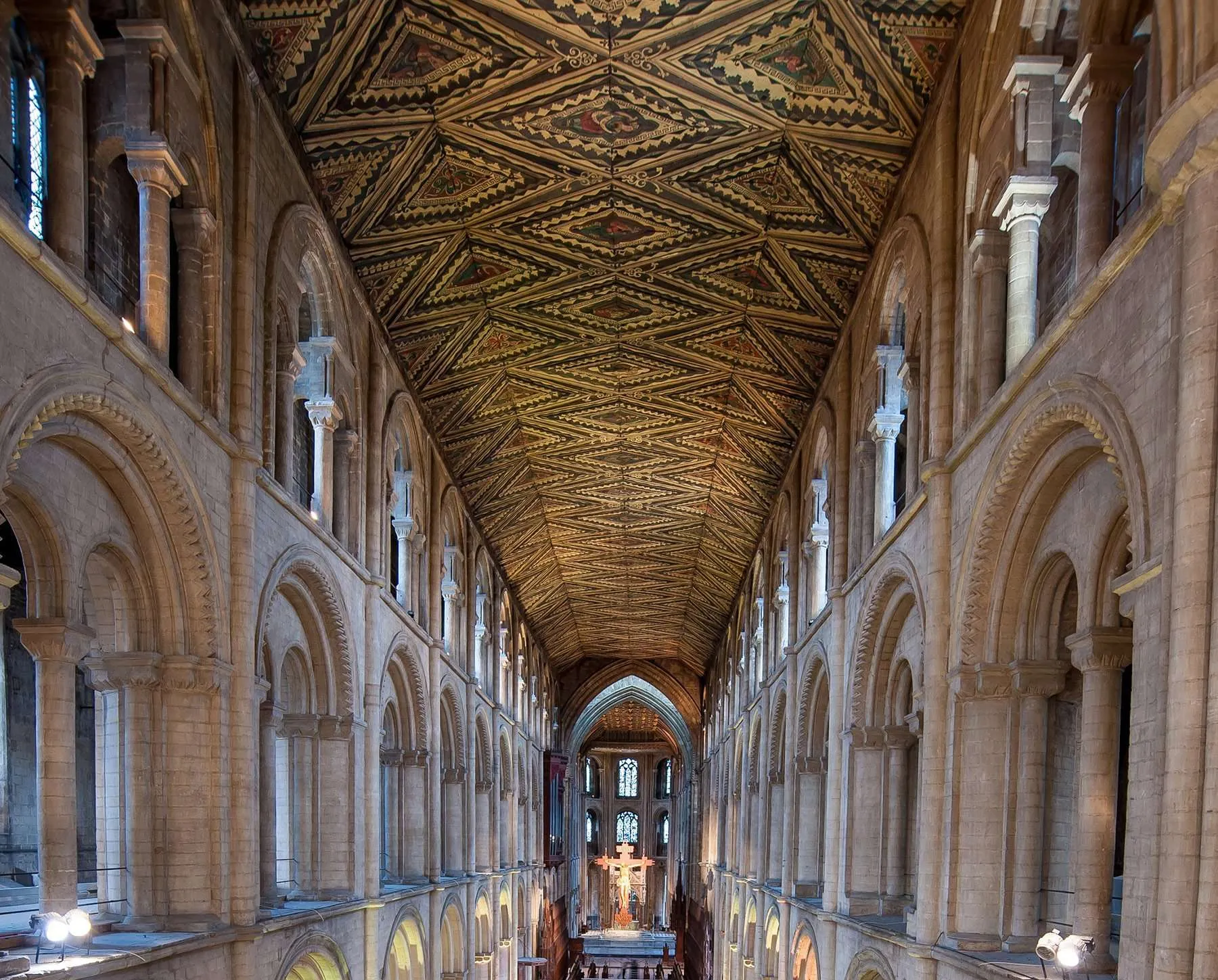
The monastery that stood here was an old one even by English standards — founded as a monastic community in 654 — and it was rebuilt more than once. In 1116, a fire destroyed the monastery and much of the town around it. Work on the building that stands today began two years later, in 1118.
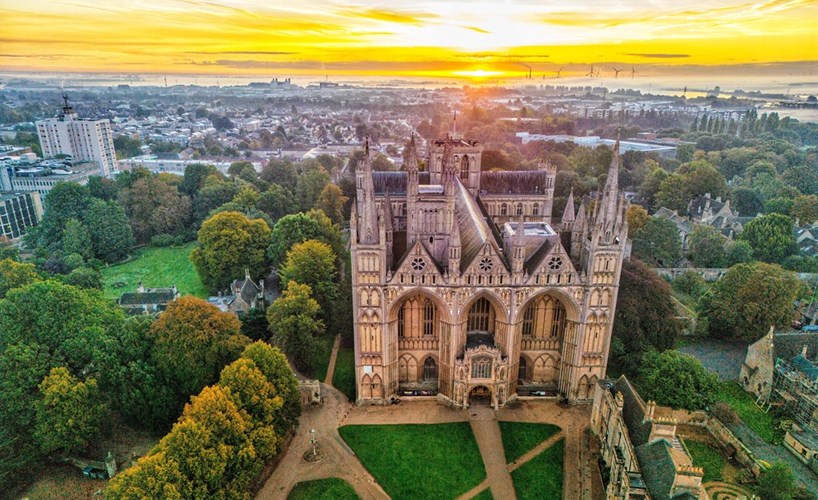
What went up was Norman, and it still reads that way: long, rounded Romanesque arches marching down the nave, heavy and regular. The new monastic church was consecrated in 1238. By then the West Front had its three enormous arches, the feature most people remember from outside, and the nave had been given the ceiling that is the real reason to come.
Look Up
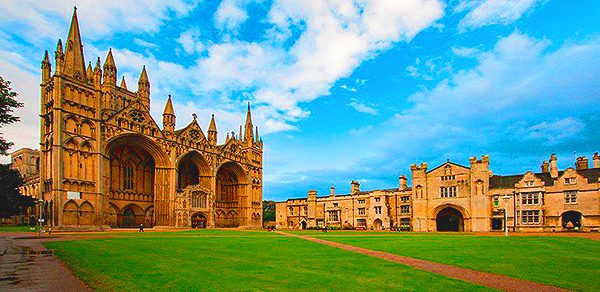
The nave ceiling is wooden, diagonally boarded and painted, and it dates from the thirteenth century. Most of the painted interiors of medieval England were lost to the Reformation, to whitewash, to damp and to time. Peterborough's survived — restored and altered over the centuries, but with its medieval scheme still legible.
The architectural historian Jonathan Foyle, who has studied it closely, describes it as the largest ceiling of its type in Europe, and argues that its imagery depicts the six kings whose reigns spanned the building's construction, from Henry I to Henry III. It is not simply decoration or a vague vision of heaven. In Foyle's reading it is a compendium of ideas — astronomy, kingship, the Church — worked in paint across the whole length of the nave, including, among other things, a monkey riding a goat backwards.
It is easy to miss. People walk the length of the nave looking at the arches, the floor and the tombs, and a surprising number never tip their heads back. Do. It is one of the most extraordinary things in any English cathedral, and it is directly overhead.
The Queen Who Stayed
In January 1536, Katharine of Aragon — Henry VIII's first wife, set aside so he could marry Anne Boleyn — died at Kimbolton in Huntingdonshire. She was buried here, in what was then still an abbey church, later that month.
What happened next is worth following closely. In 1539, the abbey was dissolved along with the rest of England's monasteries. In 1541, Henry made the abbey church a cathedral, with a bishop, a dean and canons. A long-standing tradition holds that Katharine's presence is what spared it. Whatever the reason, the building survived when many of England's greatest monastic churches were stripped and pulled down, and it survived under the authority of the man who had divorced the woman lying in it.
Katharine was never moved. Her grave is still here, and it remains the reason many people make the journey.
The Queen Who Left
Mary, Queen of Scots, was executed at Fotheringhay Castle, a short distance west of Peterborough, in February 1587. She was not buried until early August that year, almost six months later, when she was given a heraldic funeral here.
She stayed for twenty-five years. In 1612, her son — by then James I of England as well as James VI of Scotland — had her body moved to Westminster Abbey, where she now lies not far from Elizabeth I, the cousin who had signed her death warrant.
So the cathedral holds one queen who remains and the empty place of another who was taken away — two women whose lives became entangled with the Tudor crown, within a few yards of each other.
What Else Survived
The building did not come through the seventeenth century untouched. In 1643, during the Civil War, Parliamentarian troops plundered and severely damaged the cathedral. Repair and restoration followed in successive campaigns, including major nineteenth-century interventions.
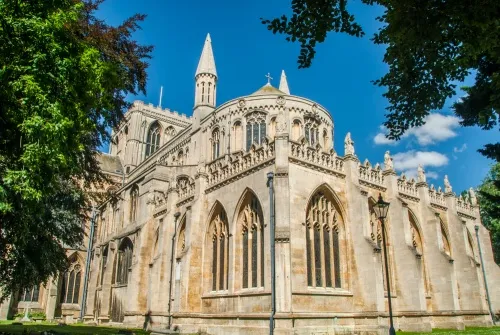
Much remains that is older than either. The Hedda Stone, an early ninth-century Saxon carving from the earlier church on this site, is among the most remarkable pieces here. At the east end, the late fifteenth-century "New Building" has fan vaulting of the kind usually associated with far more famous buildings. And the cathedral's historic precincts make a genuinely quiet enclosure in the middle of a busy city.
Why It Earns Its Place
Because it is far better than its reputation.
Peterborough isn't a city most people think of as a destination. Yet its cathedral holds the grave of one queen and the memory of another, came through the Dissolution in circumstances that still invite speculation, and carries above its nave a painted medieval ceiling of extraordinary scale.
Most visitors come for the tombs and leave having seen them. The better visit is the one where you spend as long looking up as you do looking down.
The Lifestyle Edit Scorecard
- Architecture
- 9.7 / 10
- History
- 9.6 / 10
- Setting
- 8.8 / 10
- Experience
- 9.1 / 10
Who it's for
- Anyone interested in Tudor history, particularly Katharine of Aragon and Mary, Queen of Scots; visitors who want to see one of the great survivals of medieval English painting; and anyone passing through Peterborough on the train who has an hour to spare and no idea what they're missing.
Questions
- Is Katharine of Aragon buried in Peterborough Cathedral?
- Yes. Katharine of Aragon, the first wife of Henry VIII, was buried here in January 1536, when the building was still an abbey church. Her grave remains in the cathedral.
- Was Mary, Queen of Scots, buried at Peterborough?
- Yes, for twenty-five years. After her execution at Fotheringhay Castle in February 1587, she was buried at Peterborough in early August that year. In 1612, her son James I had her body moved to Westminster Abbey.
- What is special about the ceiling?
- The nave has a painted wooden ceiling dating from the thirteenth century, restored and altered over the centuries but with its medieval scheme still legible. Architectural historian Jonathan Foyle describes it as the largest ceiling of its type in Europe and has argued that its imagery depicts the six kings who reigned while the building was constructed.
- How old is Peterborough Cathedral?
- A monastic community was founded on the site in 654. After a fire in 1116, work on the present building began in 1118, and the new church was consecrated in 1238. It became a cathedral in 1541.
- Why wasn't Peterborough Abbey destroyed at the Dissolution?
- The abbey was dissolved in 1539, but in 1541 Henry VIII made the church a cathedral. A long-standing tradition attributes its survival to Katharine of Aragon's burial there.
- What is the Hedda Stone?
- An early ninth-century Saxon carving from the earlier church that stood on the site, now one of the oldest objects in the cathedral.
- How far is it from Peterborough United's ground?
- About a ten-minute walk. The cathedral is in the city centre; London Road is just across the River Nene in Fletton.