Living
The George of Stamford — The Hotel the Road Left Behind
For centuries, one of the principal roads through England ran straight past The George, and coaches arrived from London and York to change horses in its yard. Then, in 1960, the A1 was diverted around Stamford and the traffic disappeared from St Martin's. The George stayed where it was, and more than six decades later that may be one of the reasons it remains such an unusually convincing hotel.
By James B. Stoney, Editor · 23 September 2026
Before the Coaches
Trying to give The George a birthday is difficult. The hotel itself advances a history stretching back more than a thousand years, but Historic England gives us firmer ground. The Grade II* listing describes a complex containing a mid-13th-century rear court, remains of seventeenth-century buildings and part of a medieval hall probably dating from the fourteenth century. The site had previously belonged to the Knights Hospitallers.
In other words, The George isn't really one old building. It is an accumulation of them.
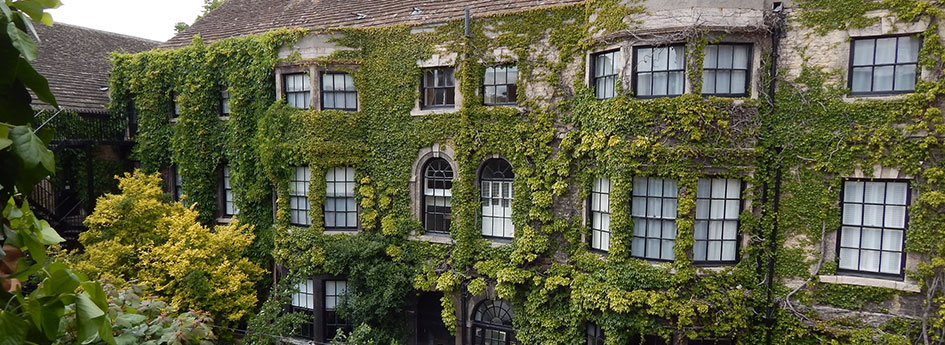
Its history also connects unexpectedly back towards Peterborough. The hotel's account records the medieval hospital on the site as having connections with Peterborough Abbey. Later came the Cecils. The George says William Cecil, Lord Burghley, rebuilt its main block in 1597; Historic England identifies the arms of the Earl of Exeter above the entrance, although the familiar ashlar frontage itself is principally eighteenth century.
That distinction matters. Calling The George simply an Elizabethan hotel doesn't quite describe what you're looking at. Medieval fabric survives inside a building altered in the seventeenth century, given much of its present street face in the eighteenth, and adapted repeatedly afterwards. The building is interesting because it never stopped changing.
Twenty Up, Twenty Down
The period that explains The George most clearly came with the coaches. Stamford sat directly on the Great North Road, the principal route north from London towards York and eventually Edinburgh, and The George became one of its great coaching inns.
According to the hotel's archive, 40 coaches passed through Stamford each day at the trade's height: twenty travelling north and twenty south. The journey from London to York had once taken four days. Later, the mail coach was allowed nine hours and twenty minutes merely to get from London to Stamford, including horse changes.
The building was arranged accordingly. Coaches entered on the north side, passed between pillars into what is now part of the dining room and continued through an arch into the yard, where horses could be changed. Passengers did not simply mill around waiting for departure. The hotel separated them by destination: one room for London, the other for York.
Both identities survive. The oak-panelled London Room is now used for private dining; across the hall, the York Bar occupies the other side of the old arrangement. It is a wonderful piece of functional history because nobody needed to recreate it for visitors. These weren't rooms subsequently named after the coaching age. They existed because coaches were coming.
When the Road Went Around
Railways began dismantling the coaching economy in the nineteenth century. The motor car eventually returned traffic to the Great North Road, but brought a different problem: too much of it.
By the twentieth century the A1 still ran through Stamford's historic streets. In 1960 a bypass opened west of the town, carrying the main north–south route away from the centre. The old road through Stamford became what is now the B1081.
For The George, the geography was reversed. For centuries, travellers had encountered the hotel because England's principal road delivered them to its door. After 1960, travellers had to choose to leave the main road and come back. The George had lost the thing that had made it commercially important, and survived it.
What Stayed
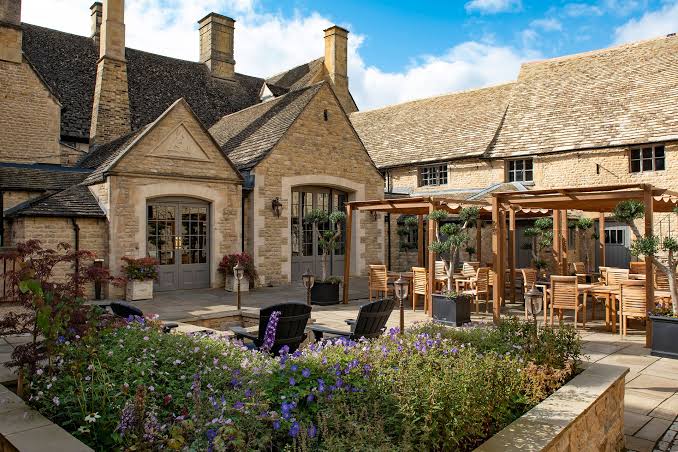
That survival is more interesting than preservation. The George isn't a coaching-inn museum. It remains a working hotel with 45 individually arranged bedrooms, restaurants, bars, private rooms and a courtyard. The hotel still makes a point of traditional service — including morning tea or coffee delivered to bedrooms and evening turndown — in a way that now feels almost anomalous among British hotels.
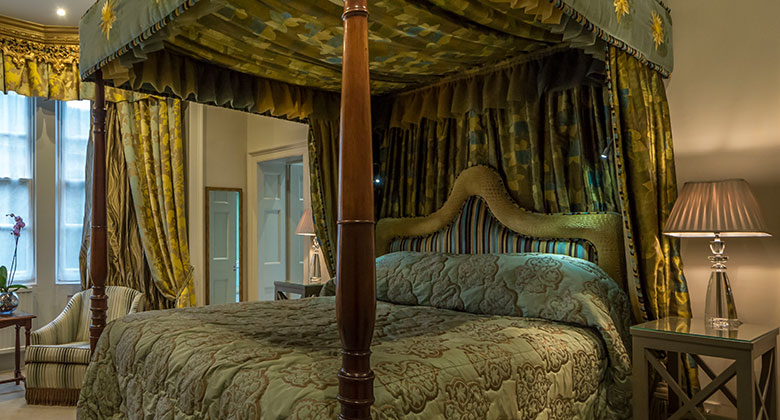
There are layers everywhere, and they are unusually easy to date. Historic England puts the front elevation in the mid-eighteenth century and records a rainwater head marked 1728; behind it, seventeenth-century remains survive to the north and rear, and the rear court is mid-thirteenth century. Part of a probable fourteenth-century hall survives inside — including, wonderfully, elements in what is now the gentlemen's lavatory. Former stables stand to the rear. The hotel's own history adds another hidden survival: above bedrooms created from a former ballroom, it says the original high ceiling and minstrels' gallery remain concealed above the modern ceilings.
This isn't preservation in the sense of freezing a building at its most photogenic historical moment. It is closer to architectural sediment. Each generation found another use for what the previous one left behind.
The Gallows
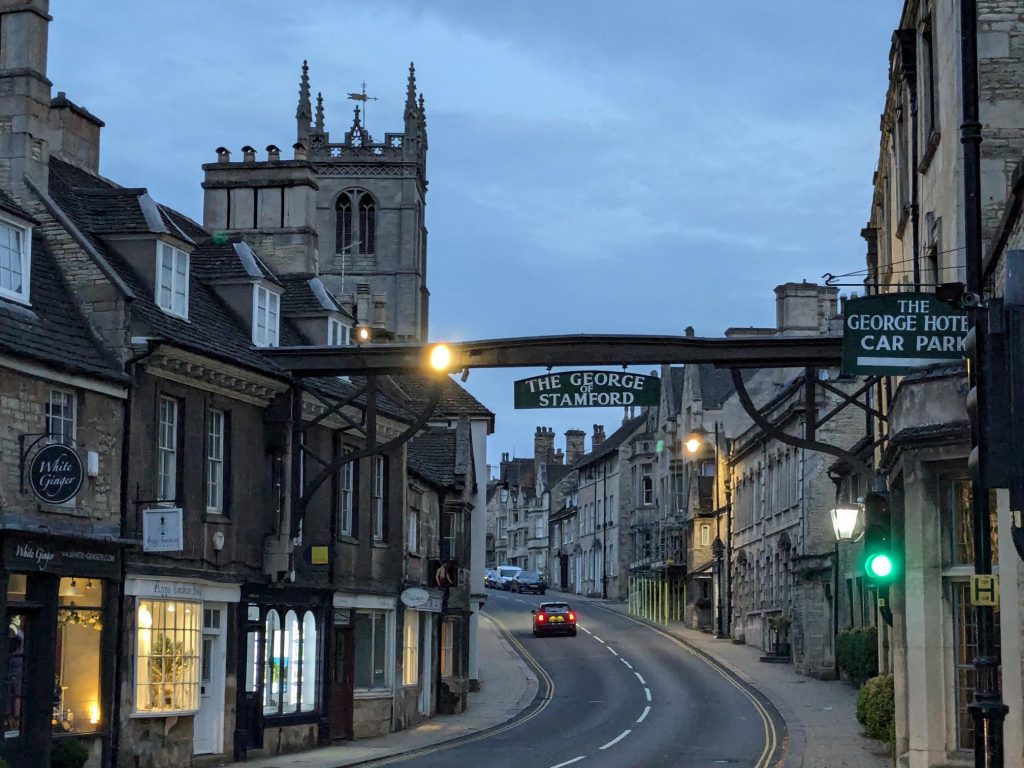
Then there is the sign. A large wooden structure stretches across the road outside The George, suspending the hotel's sign above St Martin's. It is generally known as the gallows sign, and it has become almost inseparable from the hotel's identity.
The hotel's history says it was erected as both a welcome to honest travellers and a warning to highwaymen, invoking the danger posed by figures such as Dick Turpin. Historic England is rather more useful for dating what survives: its listing identifies the wooden sign spanning the road as nineteenth century, and the local conservation-area appraisal agrees. Again, the cautious version is better than the legend. It doesn't need Dick Turpin to make it interesting. A hotel sign still physically spanning the former Great North Road says enough.
It also still needs maintaining. After two large struts fell from the beam into the road, the damaged structure was taken down for repair, with the work coordinated around the closure of Stamford's Town Bridge so the road did not need to be closed twice. The greenheart timber was repaired rather than unnecessarily replaced, and the sign was repainted by a local signwriter before being reinstated. It is a fittingly practical footnote for a building that has survived by being looked after rather than admired.
The Hotel the Road Left Behind
The curious thing about staying at The George today is that the road is still there. You can walk out of the hotel and follow essentially the old north–south route through Stamford. The London and York rooms still make geographical sense. The coaching yard remains legible within the hotel.
What has changed is importance. The A1 now carries the long-distance traffic west of town. Most drivers can pass Stamford without seeing its centre at all. The George, once positioned directly in the flow of national movement, sits on a road that has become local.
There is an irony in that. The bypass removed the traffic that had sustained Stamford's coaching inns, but it also removed the twentieth-century traffic that threatened the character of the town around them. Seven years later, in 1967, Stamford became England's first conservation area. The road helped make The George. Leaving may have helped preserve the world around it.
Why It Earns Its Place
Because this isn't simply an old hotel. The George explains why it is where it is.
The medieval hospital, the Cecil connection, the coaching yard, the London and York rooms, the stables and the sign across the street all belong to successive versions of the same function: accommodating people moving through England. Then the movement shifted elsewhere, and The George had to become somewhere worth travelling to, rather than somewhere travellers inevitably passed.
That is the more interesting survival. The coaches disappeared. The A1 moved. The hotel stayed.
The Lifestyle Edit Scorecard
- History
- 9.8 / 10
- Character
- 9.5 / 10
- Setting
- 9.4 / 10
- Stay
- 8.9 / 10
Who it's for
- Anyone who prefers hotels that have accumulated their character rather than had it designed for them. The George is particularly good for travellers who want to stay in Stamford itself rather than treat the town as a day trip: somewhere where the building, the street outside and the history of travelling through the town are all part of the stay.
Questions
- How old is The George of Stamford?
- There isn't a reliable single founding date. The site has medieval origins, and Historic England records a mid-thirteenth-century rear court and remains of a probable fourteenth-century hall, alongside later seventeenth- and eighteenth-century work.
- Was The George a coaching inn?
- Yes. It was one of Stamford's major Great North Road coaching inns. The hotel records as many as 40 coaches passing through Stamford each day at the height of the trade.
- What are the London and York rooms?
- They originated as waiting rooms for passengers travelling in the respective directions. The London Room survives as a private dining room; the York side survives as the York Bar.
- When did the A1 stop running through Stamford?
- Stamford's western bypass opened in 1960, diverting the main north–south traffic away from the historic centre.
- Is The George listed?
- Yes. The George Hotel is Grade II* listed.
- How many bedrooms does it have?
- The hotel currently advertises 45 individually designed bedrooms.
- Is the gallows sign outside The George genuinely historic?
- Yes, although some of the stories attached to it are harder to establish. Historic England and the local conservation-area appraisal both date the wooden sign spanning the road to the nineteenth century, while the hotel's own account describes it as eighteenth. It was repaired and reinstated in recent years after storm damage.