Experience
Bunkers del Carmel — The Neighbourhood That Outlasted the War
Everyone climbs the Turó de la Rovira for the view. Almost nobody knows that the concrete they're sitting on was never a bunker, or that around 600 people lived up here for four decades after the guns fell silent.
By James B. Stoney, Editor · 17 September 2026
Why the Hill
The Republic's anti-aircraft command chose the Turó de la Rovira for two reasons: an uninterrupted sightline across the whole plain of Barcelona, and proximity to the sea, which is where the attacks came from.
Construction began in 1937, and the battery entered service on 3 March 1938. Four Vickers 105mm guns were installed, supported by machine guns, an ammunition store and full infrastructure for the troops manning it — dormitories, kitchens, showers. It was one corner of a triangle, with further batteries on Montjuïc and at Poblenou.
What it was defending against is worth stating plainly. Barcelona became one of the major European examples of sustained aerial bombardment of a densely populated city, with civilians repeatedly exposed to attacks as well as military and industrial targets. The raids were flown principally by the Italian Aviazione Legionaria out of Majorca, later joined by German and Spanish fascist air power.
The battery's effectiveness was limited. The guns could not reach high-flying aircraft reliably, and gunners deliberately fired slowly to avoid running out of ammunition. What the anti-aircraft defences achieved was less interception than deterrence: bombers were forced higher and made more cautious, and the alarm system bought time for the city's roughly one thousand underground shelters to fill.
As Republican forces retreated from Barcelona in January 1939, the guns were disabled to prevent their use by the advancing Nationalist forces.
The Part Nobody Mentions
Here is what the viewpoint signage tends to compress into a sentence, and what is actually the longest chapter in the hill's modern history.
Post-war Spain was poor, and Barcelona had a severe housing shortage made worse by migration from the rest of the country. From the late 1940s, people began moving into the abandoned military structures on the Turó de la Rovira — the empty magazines, the command post, the barracks — and building around them.
What grew was an informal settlement known as the Barri dels Canons, the neighbourhood of the cannons. At its height there were around 110 dwellings and 600 people here. Residents built homes around and within the abandoned military infrastructure, organised for basic services and eventually campaigned for rehousing.
The battery was operational for about two years. People lived here for roughly four decades. The last shanties disappeared in 1990, just two years before the Olympic Games transformed Barcelona's international image.
If you look down rather than out, patches of household floor tile are still visible where rooms used to be — something the site's own interpretation points out, and which almost everyone misses.
What You See Now
The site has been a public open-air museum since the Barcelona City History Museum, MUHBA, established a free exhibition space here in 2015. It covers both histories — the battery, and the neighbourhood that followed it — through photographs, film and testimony.
Access is free. A night-time closure was introduced in 2023 after years of complaints about noise from sunset crowds, which is itself a small piece of Barcelona's present: a hilltop in a residential district that became a destination faster than the district could absorb it.
Getting up is a climb whichever way you come. Bus 119 runs closest, or there is a steady walk up from the Guinardó side. Take water in summer; there is almost no shade on top.
The View
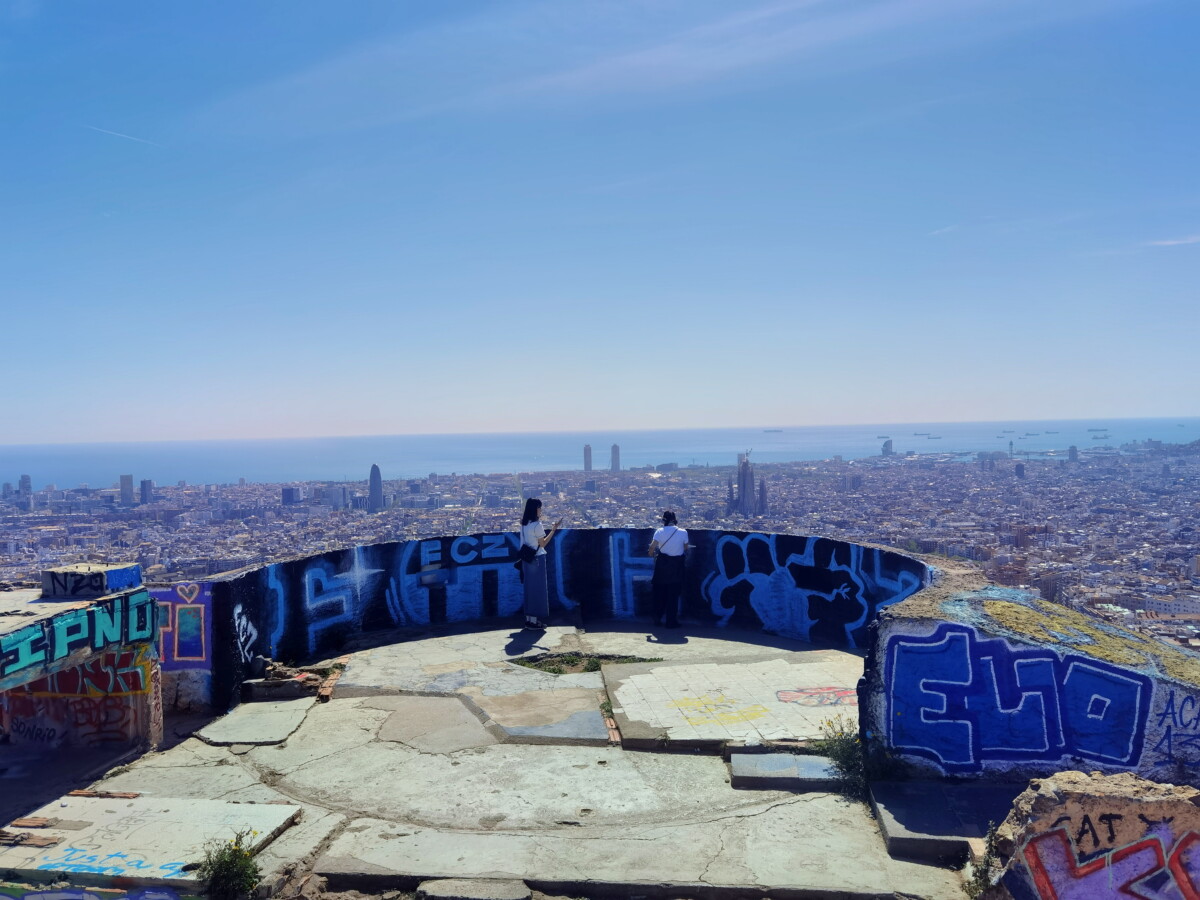
It deserves its reputation. From 262 metres you get the whole plain at once: the Sagrada Família rising out of the Eixample grid, the Torre Glòries, the sea beyond the Barceloneta, Montjuïc to the south, the Collserola ridge behind you. Very few cities let you take in their entire structure in a single turn, and Barcelona's rigid nineteenth-century grid makes it unusually legible from above.
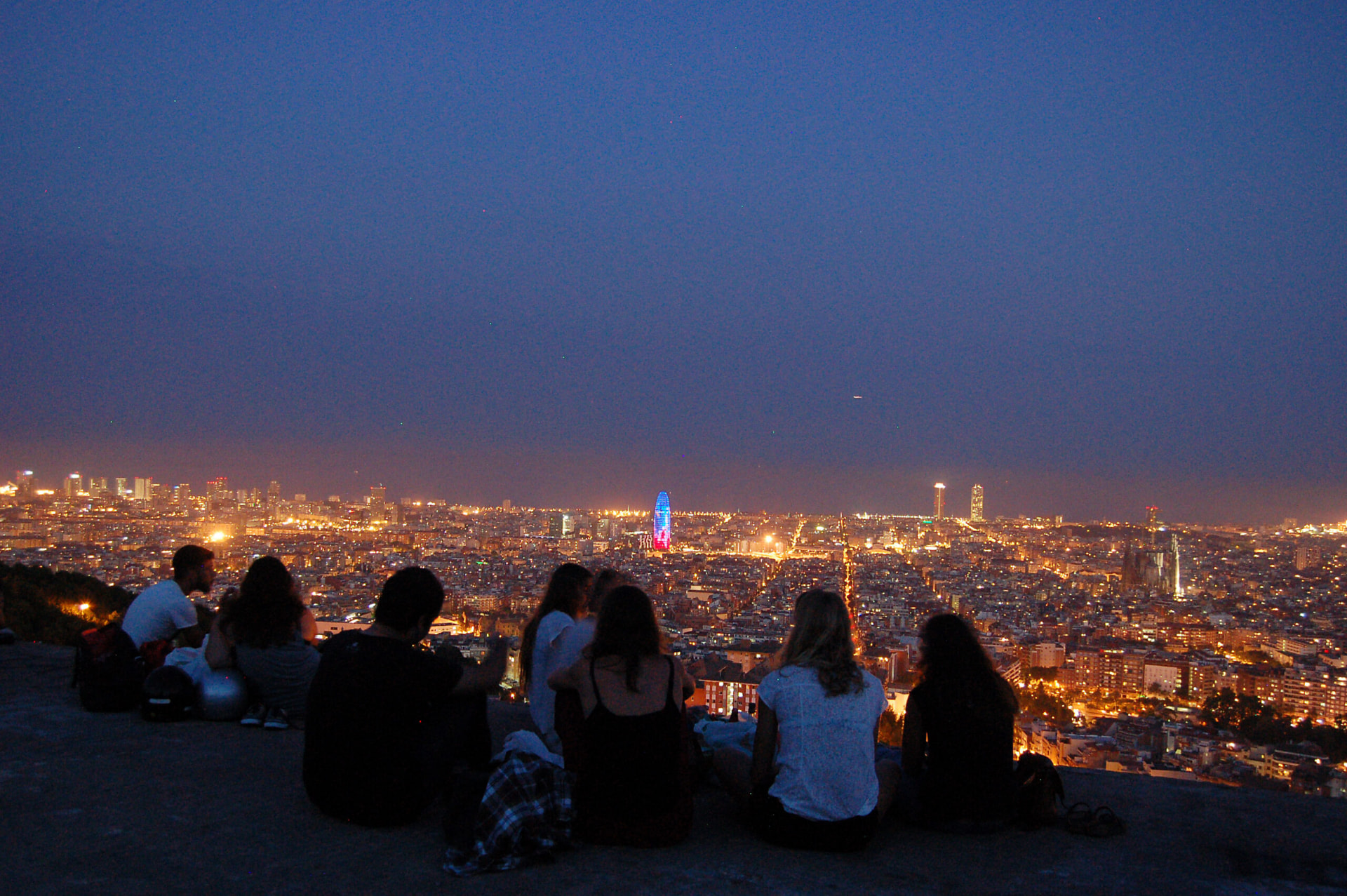
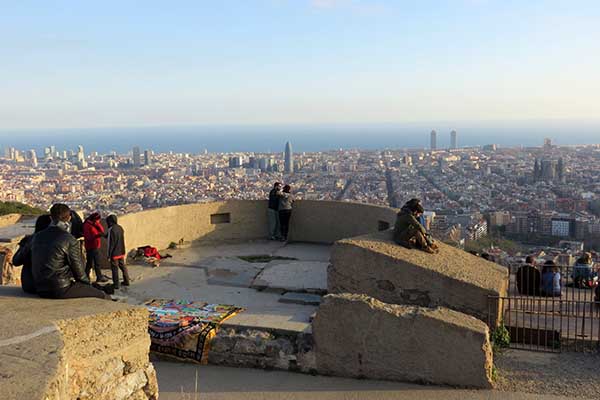
Sunset is when everyone comes, which is both the appeal and the problem. Late morning is emptier, the light is flatter but the visibility is often better, and you can actually look at the concrete you're standing on.
Why It Earns Its Place
Because the view is the least interesting thing about it.
Thousands of people come up here every week for a photograph, sit on a gun emplacement, and leave without registering that they were sitting on a gun emplacement — or that the flat concrete surfaces around them were the floors of somebody's home.
The name is wrong, the war is the shortest chapter, and the part that lasted longest has almost entirely vanished except in floor tiles and a small free museum most visitors walk past. It is a genuinely extraordinary place to look at Barcelona from. It is a more extraordinary place to look down at.
The Lifestyle Edit Scorecard
- View
- 9.8 / 10
- History
- 9.5 / 10
- Interpretation
- 9.0 / 10
- Access
- 9.1 / 10
Who it's for
- Anyone who wants a complete panorama of Barcelona.
- Visitors interested in the Civil War and in the city's post-war history, which is far less commemorated.
- Walkers who don't mind a proper climb for it. Not for anyone expecting a quiet sunset — go in the morning for that.
Questions
- What are the Bunkers del Carmel?
- The remains of a Republican anti-aircraft battery built in 1937 on the Turó de la Rovira in Barcelona's El Carmel district, now a free public viewpoint and open-air museum.
- Are the Bunkers del Carmel actually bunkers?
- No. A bunker is an enclosed protective structure. What survives here are open-air concrete gun emplacements, along with the remains of the command post, barracks and ammunition stores. The name stuck regardless.
- How much does it cost to visit?
- Nothing. Access to the site and the MUHBA exhibition space is free.
- What time do the Bunkers del Carmel open?
- The archaeological enclosure opens 9am to 7.30pm from 1 May to 30 September, and 9am to 5.30pm from 1 October to 30 April. The museum spaces themselves keep narrower hours.
- What was the Barri dels Canons?
- An informal settlement that grew on the hill from the late 1940s, as people moved into the abandoned military buildings during Barcelona's post-war housing shortage. At its height it held around 110 dwellings and 600 residents. It lasted roughly four decades, with the last shanties disappearing in 1990.
- How do you get to the Bunkers del Carmel?
- Bus 119 stops closest to the summit. Otherwise it's a steep walk up from the Guinardó or El Carmel side. There's no shade at the top, so take water in warm weather.
- Is it worth going for sunset?
- The light is best then and so are the crowds, in both senses. Late morning is considerably quieter and often clearer.