Living — Architecture
Palacio Villapanés — Sleeping Inside Old Seville
Seville has plenty of hotels that borrow the language of the city's old houses. Palacio Villapanés has the advantage of actually being one.
By James B. Stoney, Editor · 1 September 2026
Seville has plenty of hotels that borrow the language of the city's old houses. Palacio Villapanés has the advantage of actually being one.
Behind a long façade on Calle Santiago sits an 18th-century casa-palacio built around courtyards, columns, gardens and rooms originally intended for an entirely different kind of life.
It was commissioned by Admiral López-Pintado and designed by Diego Antonio Díaz, master builder to the Archbishopric of Seville, around 1729.
Almost three centuries later, you can sleep inside it.
That sounds like an obvious selling point. What makes Villapanés more interesting is how much of the old house is still allowed to behave like one.
A House Before It Was a Hotel
The original building followed a familiar Sevillian arrangement.
Rather than presenting itself entirely to the street, much of the house turned inward. An entrance hall and former coach houses led towards the main courtyard, with further parts of the building arranged around it and the garden beyond.
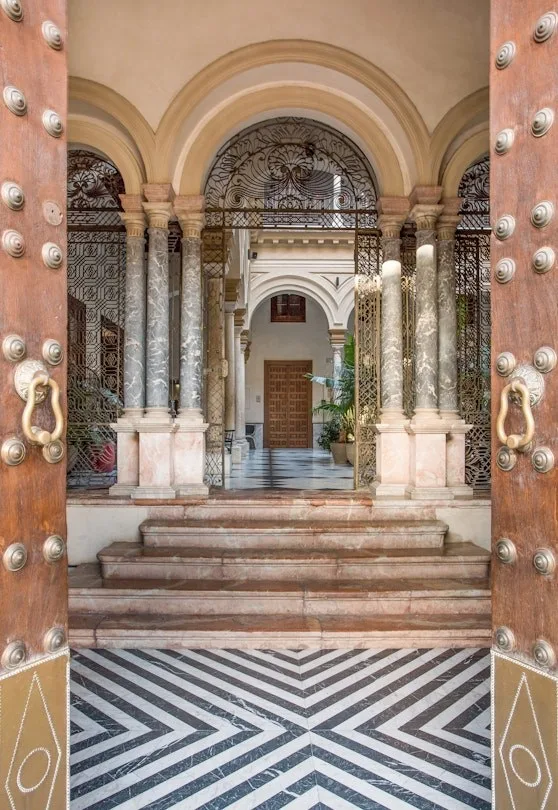
It was a practical response to Seville as much as an architectural one. Courtyards created shade and air movement; thick walls moderated the heat; the private life of the house could unfold behind a relatively restrained exterior.
López-Pintado was wealthy enough to build on a serious scale.
A senior naval officer who became Marquis of Torre Blanca de Aljarafe, he was also a landowner, businessman, breeder, winemaker and art collector. Díaz, meanwhile, was among the important architects working in 18th-century Seville.
The result is now regarded as one of the city's significant examples of Baroque civil architecture. Since December 2009, the palace has been protected by the city of Seville for its heritage value.
For a guest, the important distinction is simpler: this wasn't designed to look like a palace hotel. It was designed to be a palace.
What Survived
Historic hotels often make much of a staircase, an old wall or a few carefully preserved tiles while rebuilding almost everything around them.
Villapanés retained rather more.
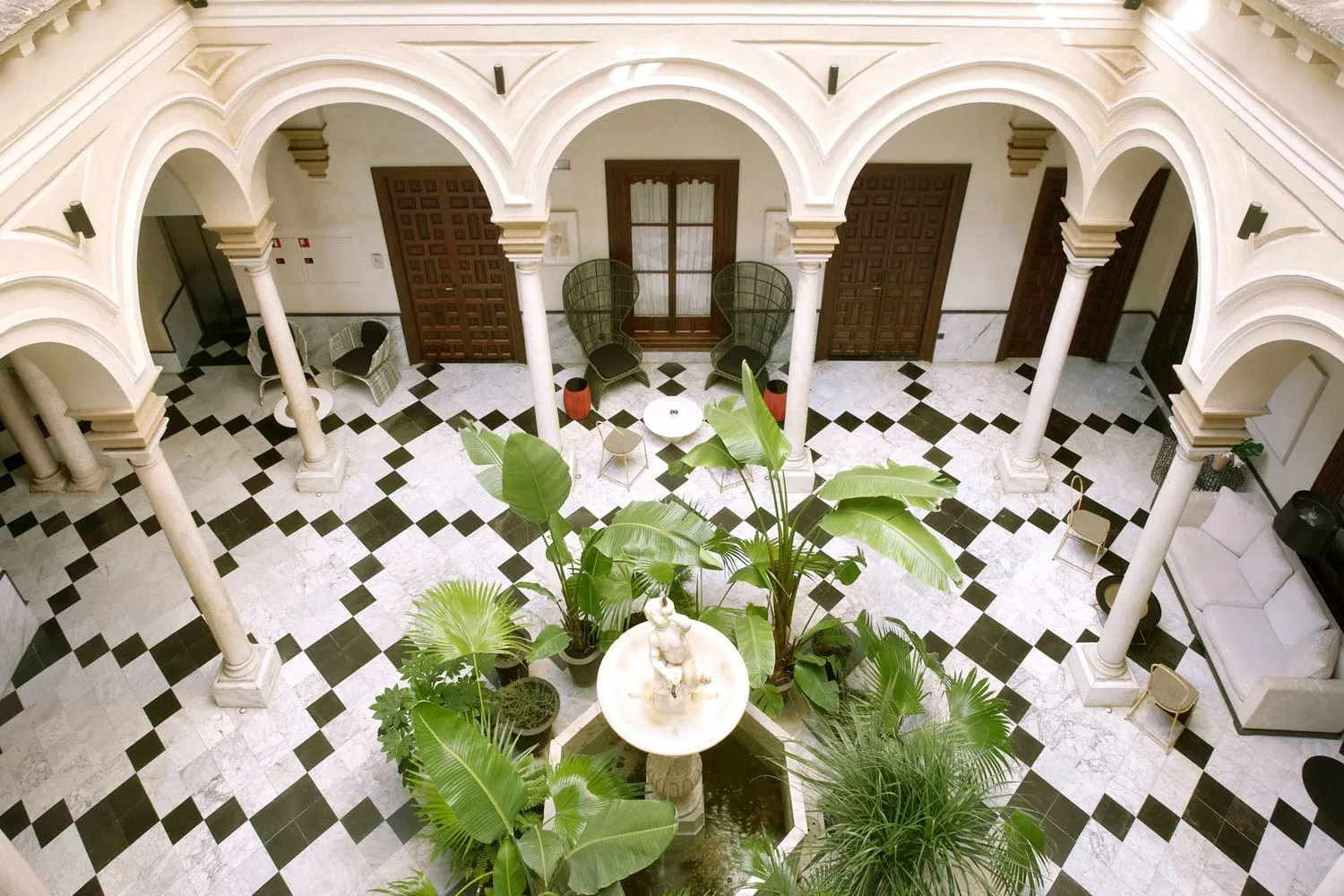
The columns of the central courtyard remain, as do wooden doors, original tiles, the noble coat of arms on the main staircase and parquet in what is now the lounge-bar. The sequence of courtyards and rooms still reflects the logic of the original house.
Contemporary pieces have been introduced rather than disguised. GCA Arquitectos and designers including Patricia Urquiola sit alongside the older architecture instead of attempting to imitate it.
That is the right decision.
Trying to make every new chair, bath and light fitting look as though it came from 1729 would turn the building into theatre. Villapanés works better when the distinction is visible: this is an old house being used now, rather than a reconstruction of how someone imagines an old house should have looked.
Fifty Rooms, But Not the Same Palace
Converting a protected palace into a hotel creates an inconvenience that is increasingly rare in modern hospitality: the architecture doesn't permit every room to be identical.
Villapanés has 50 rooms and suites, but the experience varies considerably by category.
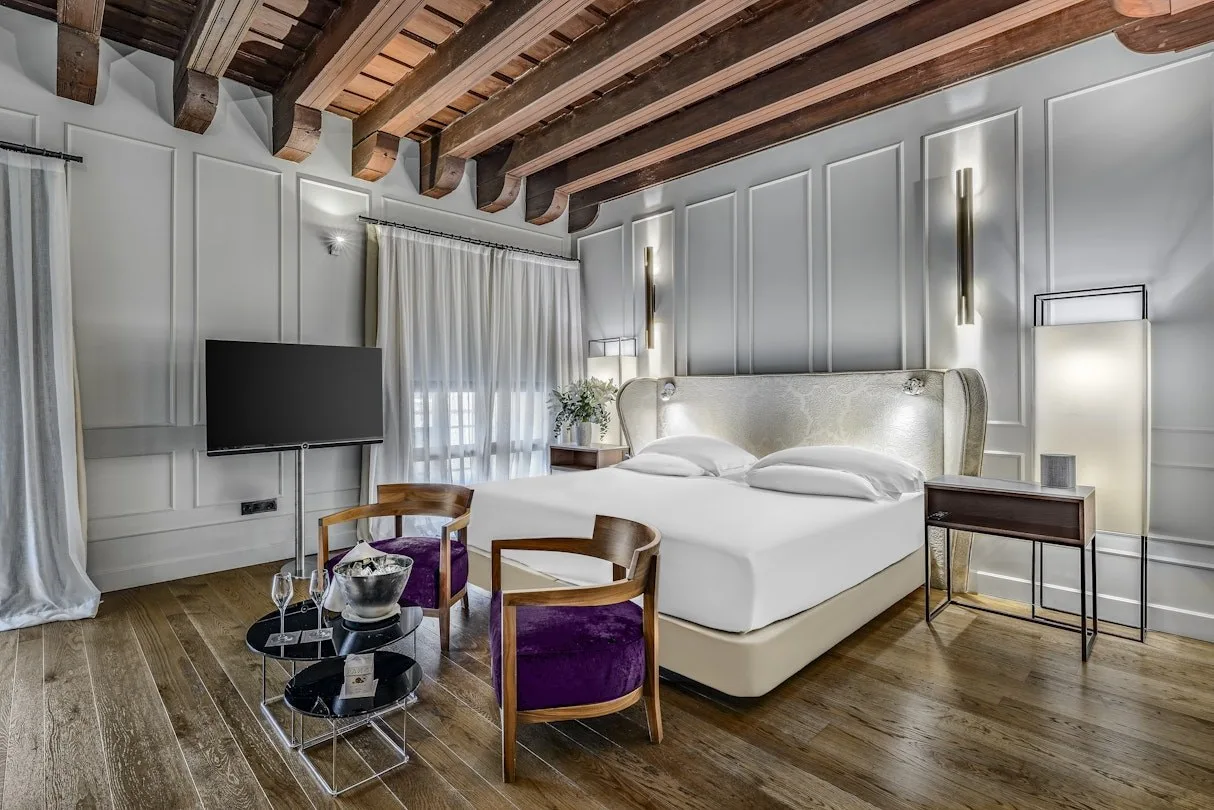
The Palace rooms and suites contain much of what people probably imagine when booking an 18th-century palacio: greater volumes, high ceilings and more conspicuous historic detailing. Some of the entry-level accommodation is simpler and less architecturally dramatic.
That isn't necessarily a reason not to book it, but it is a reason to look carefully at the room category rather than assuming every one of the hotel's 50 rooms delivers the same version of the palace.
At the extreme end is the Torreón Suite.
Set high in the historic building, it has a private terrace, coffered ceilings and a 19th-century marble bathtub. It is the kind of room that could only exist because the building existed first.
That distinction matters.
In a purpose-built luxury hotel, architecture tends to accommodate the rooms. Here, the rooms have had to accommodate the architecture.
The Palace Still Turns Inward
The rooftop inevitably gets attention.
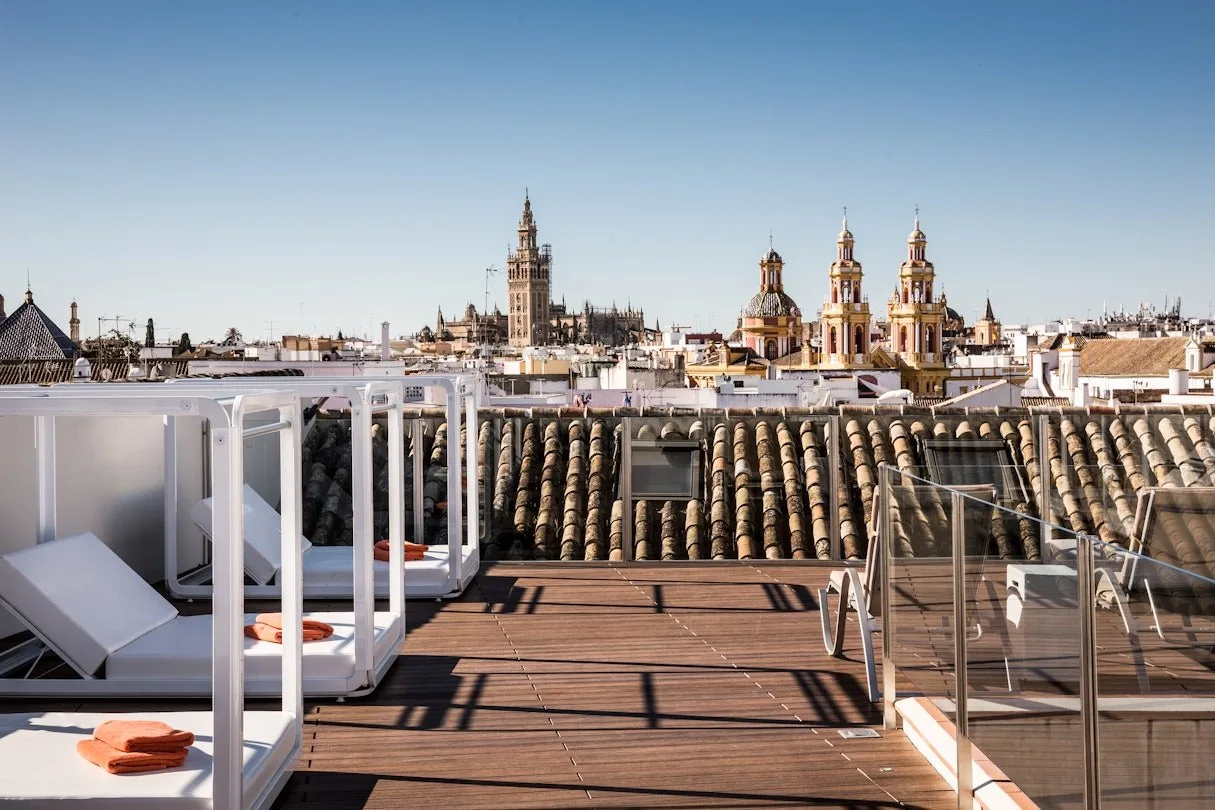
There is a small plunge pool intended more for cooling off than swimming, with views across the rooftops of Seville. It is a useful amenity in a city where summer temperatures make almost any patch of water appealing, but anyone expecting a conventional hotel swimming pool should adjust expectations.
The more characteristic spaces are lower down.
The courtyards, orange trees, columns and shaded passages are what make Villapanés specifically Sevillian rather than merely historic. They also provide a useful contrast with the city outside.
Seville can be intense. The streets are narrow, the stone holds the heat and the centre fills quickly with visitors. A casa-palacio was designed partly to create another world behind its entrance, using courtyards, shade and thick walls to separate domestic life from the street.
Villapanés still benefits from that arrangement.
A Hotel Has Been Added
None of this means pretending the building remains an untouched aristocratic residence.
It is a five-star hotel.
There is a wellness area, gym, rooftop plunge pool and restaurant, Los Rincones del Marqués. Contemporary bathrooms sit behind old walls. The rooms contain the equipment expected at this end of the market, and the restoration deliberately combines historical details with modern design.
That intervention is unavoidable.
The more interesting question with buildings like this is whether the hotel overwhelms the building or allows the building to remain the most interesting thing about the hotel. It is the same question that runs through Casa La Siesta, a few hours south in the Cádiz countryside.
At Villapanés, the balance largely holds.
Why It Earns Its Place
Villapanés began as a private expression of wealth, status and Sevillian domestic architecture in 1729. Nearly three centuries later, its purpose has changed completely, but the building hasn't been made anonymous in the process.
You still enter from the street and move inwards. The courtyard still organises the house. Shade, thick walls and enclosed spaces still make sense in the Seville heat. In the more historic room categories, the scale and surviving details reveal something of how López-Pintado intended the house to be experienced.
That continuity is more interesting than simply sleeping somewhere old.
A historic building can survive physically while losing almost everything that once made it distinctive. Here, enough of the original spatial logic remains that staying inside the palace can still help explain it.
Almost 300 years after it was built, you can understand what the building was for. The rest of Edit No.29, Andalucía, From the Field Up, follows the same thread — from El Disparate across the city to the restored pans at Salina Santa Teresa.
Vitae Lifestyle Scorecard
- Architecture & Character
- 9.4 / 10
- Rooms
- 9.1 / 10
- Setting
- 9.2 / 10
- Sense of Place
- 9.4 / 10
Who it's for
- Travellers who want to stay somewhere specifically Sevillian rather than simply choose a luxury hotel in Seville.
- Anyone interested in architecture and historic buildings.
- Couples looking for somewhere central enough to explore the city on foot but capable of feeling removed from it once the front door closes.
- Room choice matters here: travellers booking primarily for the palace architecture should look beyond the entry categories towards the Palace rooms and suites.
Questions
- Where is Palacio Villapanés?
- CoolRooms Palacio Villapanés is at Calle Santiago 31 in Seville's historic centre.
- How old is Palacio Villapanés?
- The palace was built around 1729. It was designed by Diego Antonio Díaz and commissioned by Admiral López-Pintado, who later held the title Marquis of Torre Blanca de Aljarafe.
- How many rooms does Palacio Villapanés have?
- The hotel has 50 rooms and suites. Because they occupy different parts of an existing historic property, their dimensions, outlooks and architectural character vary.
- Which rooms have the strongest historic character?
- The Palace rooms and suites generally provide more of the scale and architectural detailing associated with the original casa-palacio. Entry-level rooms can be simpler, so it is worth comparing categories if the historic interiors are an important reason for staying.
- Is Palacio Villapanés a real palace?
- Yes. The hotel occupies a remodelled 18th-century Sevillian casa-palacio rather than a modern building designed in a palatial style. The historic property has protected heritage status in Seville.
- Does Palacio Villapanés have a swimming pool?
- There is a small rooftop plunge pool intended primarily for cooling off rather than conventional swimming.
- Does Palacio Villapanés have a spa?
- Yes. The hotel has a wellness area alongside a gym and treatment facilities.
- What is the Torreón Suite?
- The Torreón is one of the hotel's most distinctive suites, positioned high in the historic building and featuring a private terrace, coffered ceilings and a 19th-century marble bathtub.