Living — Wellness
Beaverbrook — The Country House Estate Rebuilt Around Wellness
Churchill once came for the company. But the most interesting evolution at Beaverbrook is happening away from the main house, beneath Brian Clarke's stained glass and out in the meadow.
By James B. Stoney, Editor · 22 August 2026
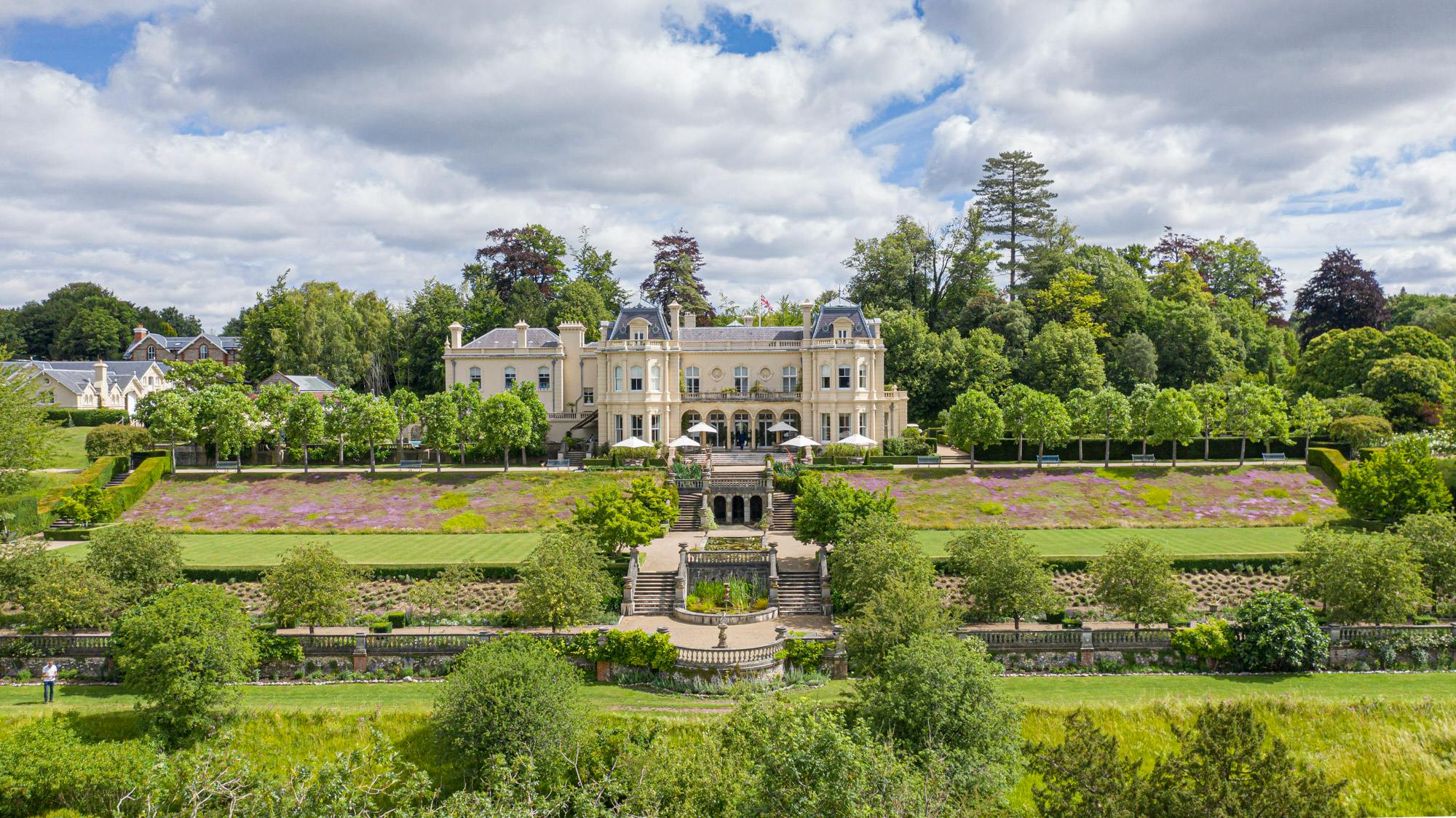
Beaverbrook has enough history to coast on it indefinitely. Lord Beaverbrook bought the Surrey estate in 1910 after spotting the for-sale sign while driving with Rudyard Kipling. Winston Churchill became a regular visitor. During the Second World War, Beaverbrook served as Minister of Aircraft Production, while his country estate remained closely connected to the political world around him.
Today, however, one of the strongest reasons to come has little to do with the famous guest book. It's the spa.
A Different Starting Point
The late-Victorian mansion became the home of Max Aitken, later Lord Beaverbrook, who turned it into the kind of country retreat only a newspaper proprietor and political powerbroker could have assembled. Electricity, heating, a swimming pool and one of Britain's earliest private cinemas were added. Politicians, writers and actors followed.
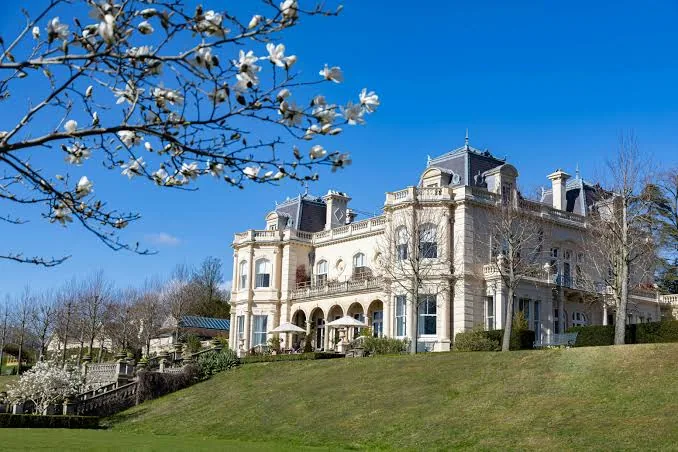
The modern Beaverbrook has retained much of that personality while expanding into something considerably broader. Accommodation now spreads across four parts of the estate — The House, The Village, The Garden House and The Coach House — surrounded by the Surrey Hills. But the most interesting departure from the old country-house formula sits at the Coach House.
A Spa Designed as Art
The first thing that separates the Coach House Spa from a conventional hotel spa is above your head. British artist Brian Clarke was commissioned to design its stained glass, mosaics and other visual elements, taking inspiration from flowers growing on the estate. Vast areas of coloured glass throw changing light across the pools and tiled interiors. Beaverbrook describes the result as a Gesamtkunstwerk — essentially a space in which art and architecture become a single work.
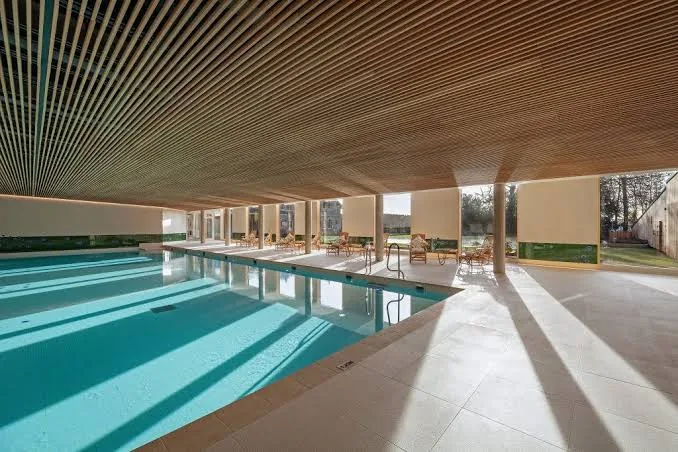
That attention extends outside. An apothecary garden grows medicinal plants and flowers used in treatments and teas. Water runs through the building in rills, while private treatment gardens and woodland trails pull the surrounding estate into the spa rather than sealing guests away from it. The facilities themselves are substantial: six treatment rooms, a 20-metre indoor pool, heated outdoor pool, sauna, steam room, jacuzzi, ice fountain, gym and a hyperbaric oxygen chamber.
Out Into the Meadow
The most distinctive treatment takes place away from most of them. Walk barefoot through the wildflower meadow and you reach the Meadow Hut, a small private treatment space surrounded by the estate.
Beaverbrook's 90-minute Vibrational Sound Bodywork treatment begins with a cleansing ritual using sage and rosemary before moving into sound immersion with Tibetan bowls, gongs and chimes. Breath awareness follows, before the session finishes with a personalised biodynamic full-body massage using Coach House essential oils.
There are plenty of hotel spas now offering a sound bath somewhere on the treatment list. The difference here is the degree to which the environment has been built around it. You leave the main spa. You walk through the meadow. The treatment has its own building, its own sequence and its own relationship with the landscape outside. It feels like programming rather than an add-on.
Beyond the Massage Menu
The broader wellness programme is similarly ambitious. Alongside conventional massages and facials sit naturopathy, Pilates, yoga, specialist mobility work and hyperbaric oxygen therapy. Current spa days range from lymphatic treatments and hammam rituals to floating sound healing and a functional-medicine health reset.
Not every claim made around modern wellness therapies carries the same evidential weight, of course. What's distinctive about Beaverbrook isn't that every treatment promises something revolutionary. It's the breadth and seriousness with which the estate has approached the category. The Coach House doesn't feel like a swimming pool and four treatment rooms added because a luxury hotel is expected to have them. It has become a substantial part of Beaverbrook's identity.
The Estate Around It
That matters because Beaverbrook works particularly well as a whole-estate experience. There are restaurants and bars across the property, walking trails through the grounds and accommodation immediately behind the spa. Coach House guests have direct access to its facilities, while an overnight Spa Escape combines a treatment with full use of the pools and thermal areas.
It makes staying here different from driving to a spa, having a massage and leaving. The idea is to disappear into the estate for a while.
Why It Earns Its Place
Beaverbrook could have remained a beautifully restored country house with an exceptional history. Instead, it's built one of its most contemporary reasons to visit around something entirely different.
Brian Clarke's stained glass turns the spa itself into an artwork. Plants grown outside find their way into treatments and teas. Specialist practitioners take the programme well beyond conventional facials and massages. And out in the meadow, one of its signature treatments has an entire building to itself — the same argument about doing one thing properly that runs through Edit No.28, from Foxhills and Starling to the Hannah Peschar Sculpture Garden and Botley Hill Farmhouse.
The old Beaverbrook was somewhere powerful people escaped London. The reason has changed. The instinct hasn't.
The Lifestyle Edit Scorecard
- Wellness & spa
- 9.5 / 10
- Setting
- 9.4 / 10
- Design & atmosphere
- 9.3 / 10
- Distinctiveness
- 9.0 / 10
Who it's for
- Anyone wanting a country-house break where wellness is a central part of the experience rather than an amenity downstairs.
- Spa regulars looking for treatments beyond the standard massage-and-facial menu.
- Art and design enthusiasts — Brian Clarke's work alone makes the Coach House unusually distinctive.
- Londoners wanting to disappear into a large country estate without travelling particularly far.
Questions
- What makes Beaverbrook's Coach House Spa different?
- The spa was designed around major stained-glass and mosaic work by British artist Brian Clarke. It also has an apothecary garden, indoor and outdoor heated pools, thermal facilities, six treatment rooms and a hyperbaric oxygen chamber.
- What is the Meadow Hut treatment?
- The 90-minute Vibrational Sound Bodywork treatment takes place in a private hut in Beaverbrook's wildflower meadow. It combines a sage-and-rosemary cleansing ritual, sound immersion, breath awareness and biodynamic full-body massage.
- Can you visit the spa without staying overnight?
- Yes. Beaverbrook offers dedicated spa days as well as treatments and overnight spa packages. Advance booking is recommended.
- Does Beaverbrook offer wellness beyond spa treatments?
- Yes. Its current programme includes naturopathy, yoga, Pilates, personal training, mobility work and specialist spa days alongside conventional body and facial treatments.
- Who was Lord Beaverbrook?
- Max Aitken, 1st Baron Beaverbrook, was a Canadian-born newspaper proprietor and politician. He was a close friend of Winston Churchill and served as Minister of Aircraft Production during the Second World War.
- Where is Beaverbrook?
- Beaverbrook is on Reigate Road near Leatherhead, Surrey, in the Surrey Hills.