Place
Casa Mori — When Fusion Becomes Its Own Cuisine
Put the chef who coined Mod-Sin in a kitchen with the chef behind one of Singapore's better Spanish restaurants, and the obvious risk is a menu of jokes. What arrives instead is a set of dishes where one tradition keeps revealing something useful about the other.
By James B. Stoney, Editor · 1 October 2026
Two Chefs, One Kitchen
Willin Low did not invent Singaporean food. He invented a way of talking about it.
Mod-Sin — modern Singaporean — is a term he coined in 2005 when he opened Wild Rocket, built on the argument that Singaporean flavours could leave their original forms without becoming less Singaporean. Two decades later the idea is so thoroughly absorbed that it barely registers as an idea.
José Alonso came from the other direction. His Kulto established him as one of the more serious Spanish cooks in the city. The two had talked about working together for years. The opportunity finally arrived in 2026, after Low closed Relish and Alonso was offered the former La Salsa space at Dempsey.
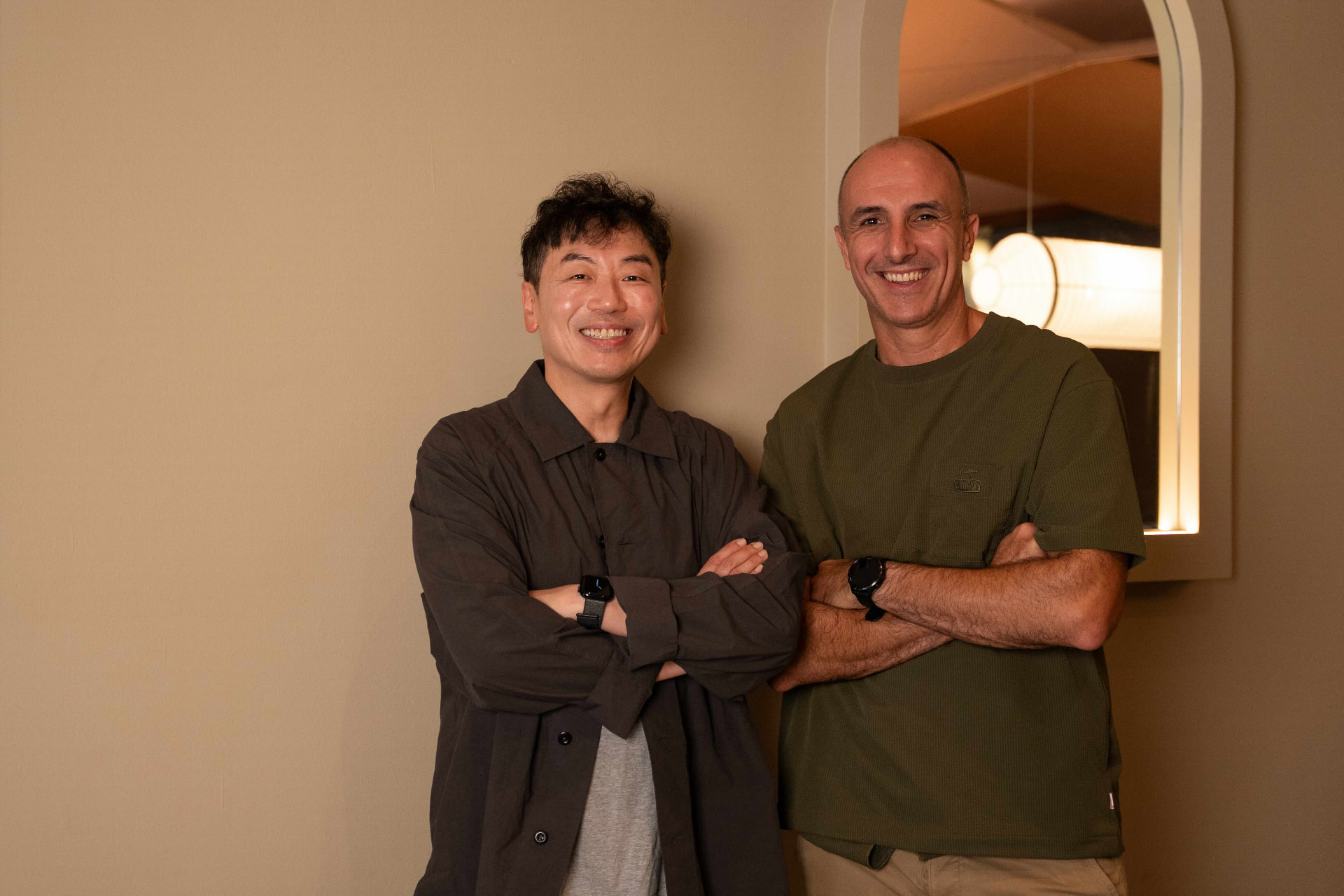
Alonso's own framing is deliberately unglamorous: high-quality European ingredients, Southeast Asian flavours and influences, a dining experience reflecting Singapore's multicultural identity. Both chefs are careful to avoid the word fusion — Low has said he dislikes it because it too often becomes confusion.
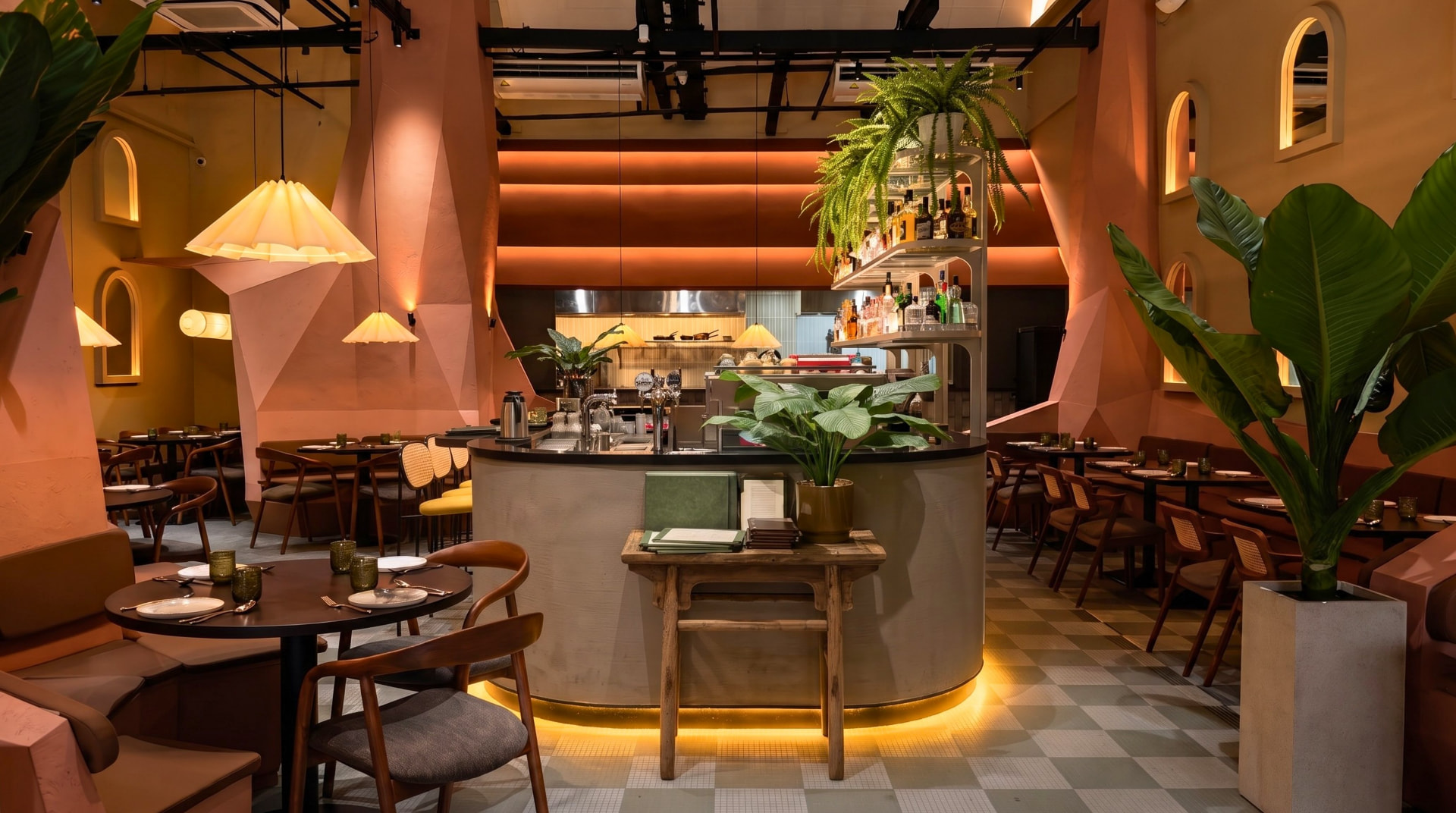
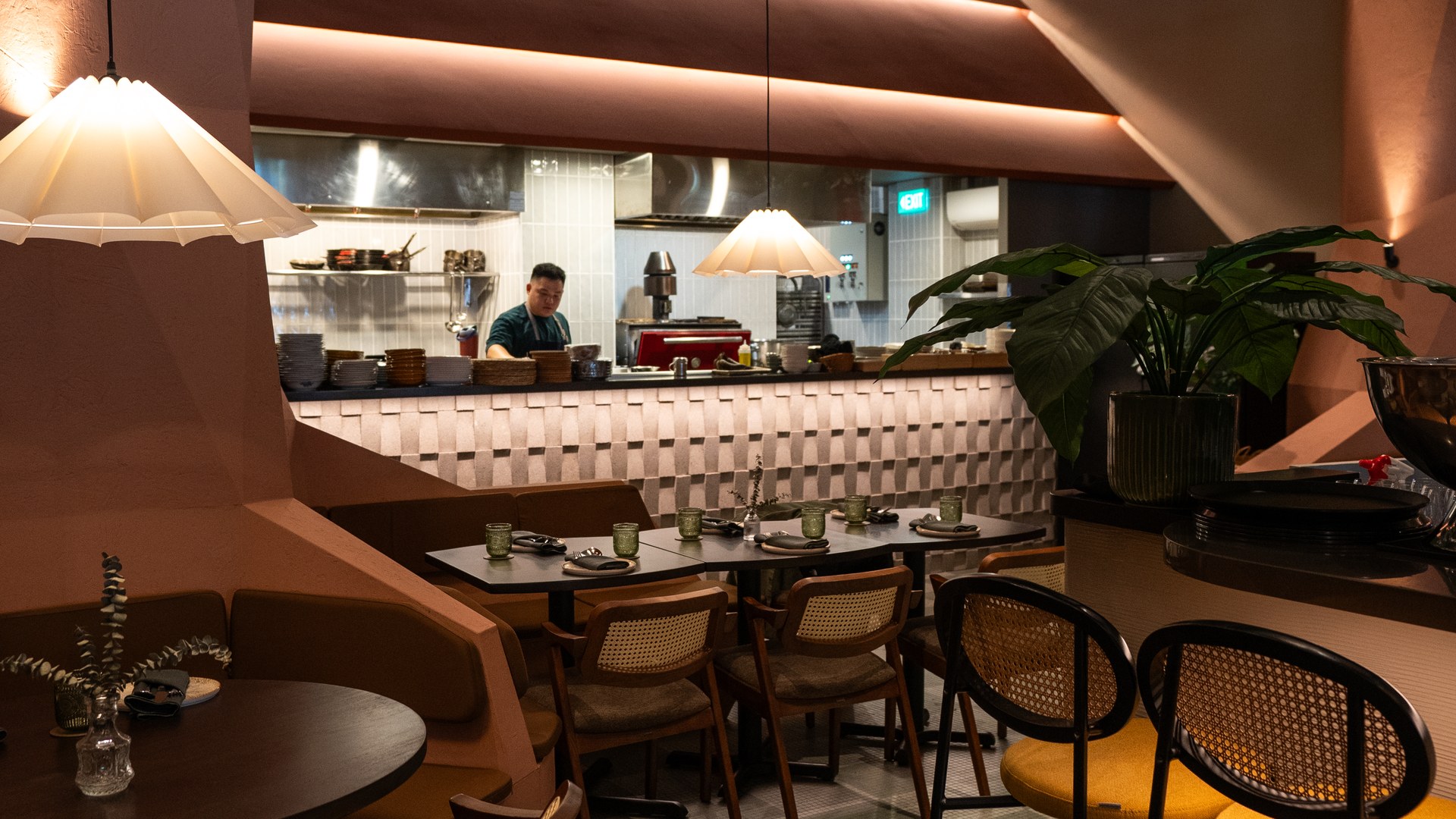
The restaurant sits among Dempsey's low-rise former military buildings, with interiors by the local studio Produce: high ceilings, terracotta tones, and columns made to resemble tree trunks. Mori is Japanese for forest. The effect is a courtyard that feels Mediterranean while being surrounded by Singaporean greenery, which is a reasonable summary of the menu as well.
One of the dishes that explains the idea most literally is the kalipoqueta — part curry puff, part croqueta, filled with chicken and potato curry, S$16 for four. It is also the easiest thing here to reduce to a pun. The dishes we tried made the argument more convincingly.
Satay, With Better Pork
The Iberico Secreto Satay makes an even simpler proposition. Take satay and change the meat.
Casa Mori uses Iberico secreto, a heavily marbled cut hidden between the shoulder and loin, and serves three skewers with an Indonesian sate glaze, pineapple and peanuts for S$24.
Other critics have found the glaze too sweet and argued that the Iberico would be better served with a more conventional peanut sauce. We didn't.
What came through was why Iberico makes sense here in the first place. Satay needs fat. Secreto has plenty of it. The pork remains juicy against the heat of the grill, while the glaze pushes the dish towards the sticky, sweet end of the satay spectrum.
It isn't trying to improve hawker satay. Nor does it need to. It is using a Spanish ingredient to exaggerate something already present in the Singaporean dish.
That distinction runs through the better cooking at Casa Mori. The successful dishes aren't hybrids for the sake of hybridity. One tradition provides a technique, ingredient or format that reveals something useful about the other.
The Dish That Explains Casa Mori
Then comes the Hokkien Mee Fideuà. If you order one thing here, make it this.
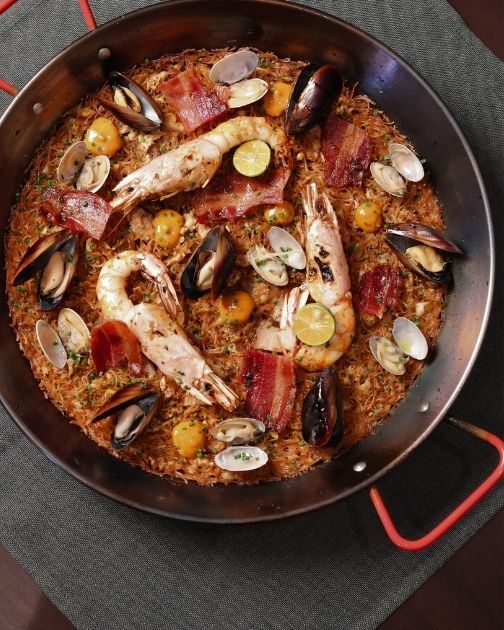
Fideuà is the obvious Spanish partner for Hokkien mee because it already occupies similar territory: noodles cooked in a broad pan with seafood and stock, taking flavour from the liquid around them. Casa Mori builds its S$58 version around Argentinian red prawns, clams, mussels and bacon. It arrives in the pan, unmistakably fideuà in appearance, while the aroma belongs somewhere considerably closer to a Singapore hawker centre.
This is where the idea stops feeling like fusion. The noodles carry the depth of prawn broth you want from Hokkien mee, but the fideuà method changes their character. There is texture and char rather than the wetter consistency of the Singapore original. The shellfish makes sense in both languages. It is recognisable as Hokkien mee without attempting to reproduce Hokkien mee.
That is a difficult line to hold. Too faithful and there is no reason for the Spanish intervention. Too distant and the Singapore reference becomes a name on a menu. Casa Mori lands somewhere in between. It is also simply delicious.
The restaurant foregrounds it alongside the Iberico Secreto Satay and the Mochi Churros, and it has emerged as the clearest signature since opening. It deserves to.
Churros Meet Kaya
Dessert repeats the trick with less complication. The Mochi Churros are S$16: fried dough with a chewy centre, served with chocolate sauce and house-made kaya.
Chocolate is the expected partner. Kaya is the one you keep going back to.
Again, there is no great culinary thesis required. Churros need something sweet to dip into; coconut, egg and pandan work extremely well with fried dough. The mochi-like texture gives the churro more chew without taking it so far from the original that it becomes something else entirely.
By this point, a pattern has established itself. Iberico becomes satay. Hokkien mee becomes fideuà. Kaya sits beside churros. Every one could have been a gimmick. All three were delicious.
That matters more than whether anyone can decide which cuisine owns the resulting dish.
Watching the Mixing
There is a temptation to treat Casa Mori as another chapter in the history of Mod-Sin. It certainly belongs somewhere in that story. Low helped establish the idea that Singaporean flavours could move beyond their original forms without becoming less Singaporean, and two decades later that argument hardly needs making.
Casa Mori is more interesting viewed from the other direction.
Singapore has always had a cuisine built through exchange. Chinese, Malay, Indian, Peranakan, Eurasian and other traditions have overlapped for generations, and some of the foods now regarded as unmistakably Singaporean exist precisely because culinary boundaries were porous. What Casa Mori does is make that process unusually visible.
Nobody is going to mistake a kalipoqueta for something handed down through generations. Its two parents are written into its name. The Hokkien Mee Fideuà announces both sides before it reaches the table. But perhaps that is only because these combinations are new.
Cuisine tends to look fixed when you encounter it after the mixing has already happened. Casa Mori lets you watch some of the mixing in real time.
Why It Earns Its Place
Because the ideas survive contact with dinner.
It would be easy to admire Casa Mori intellectually. Willin Low and José Alonso have enough history between them to make the Singapore–Spain premise credible, and the menu contains enough wordplay and cross-cultural reference to keep a food writer occupied.
None of that would matter if the satay were a waste of Iberico, the fideuà an inferior Hokkien mee or the churros merely an excuse to put kaya somewhere unexpected. They weren't. The three dishes we tried that most clearly express the idea were all delicious.
That is ultimately the strongest argument for the restaurant. The question isn't whether a curry puff should become a croqueta or whether Hokkien mee belongs in a paella pan. Once the food works, the question becomes considerably less important.
The Lifestyle Edit Scorecard
- Food
- 9.4 / 10
- Originality
- 9.5 / 10
- Setting
- 9.1 / 10
- Value
- 8.8 / 10
Who it's for
- Anyone who has eaten enough in Singapore to recognise what the dishes are referring to — the jokes only land if you know the originals. It suits long, shared meals rather than quick ones, and Dempsey being Dempsey, it is somewhere you go deliberately rather than somewhere you pass.
- Not for purists, on either side.
Questions
- Who is behind Casa Mori?
- Willin Low, who coined the term Mod-Sin at the former Wild Rocket in 2005, and José Alonso of the Spanish restaurant Kulto. The two had discussed working together for years before the Dempsey space became available in 2026.
- Where is Casa Mori?
- 11 Dempsey Road, #01-17, Singapore 249673, among Dempsey's low-rise former military buildings.
- What kind of food does it serve?
- Singaporean and Southeast Asian flavours combined with Spanish ingredients and techniques. Both chefs avoid the term fusion.
- What should you order?
- The Hokkien Mee Fideuà (S$58) is the clearest expression of what the restaurant does. The Iberico Secreto Satay (S$24) and Mochi Churros (S$16) are the other two dishes the restaurant foregrounds.
- What is a kalipoqueta?
- Part curry puff, part Spanish croqueta, filled with chicken and potato curry. S$16 for four.
- What does the name mean?
- Mori is Japanese for forest, a reference to the dining room's columns, which are fashioned to resemble tree trunks. The interiors are by the Singapore studio Produce.