Reading
Libreria Sovilla, Cortina's Bookshop With a Literary History
A bookshop has been part of Cortina since the early twentieth century, and the Sovilla family have been running it since 1971. Their literary encounters helped establish a tradition that remains part of Italian cultural life. We went in to browse and stayed considerably longer than planned.
By James B. Stoney, Editor · 25 November 2026
Older Than the Family That Runs It
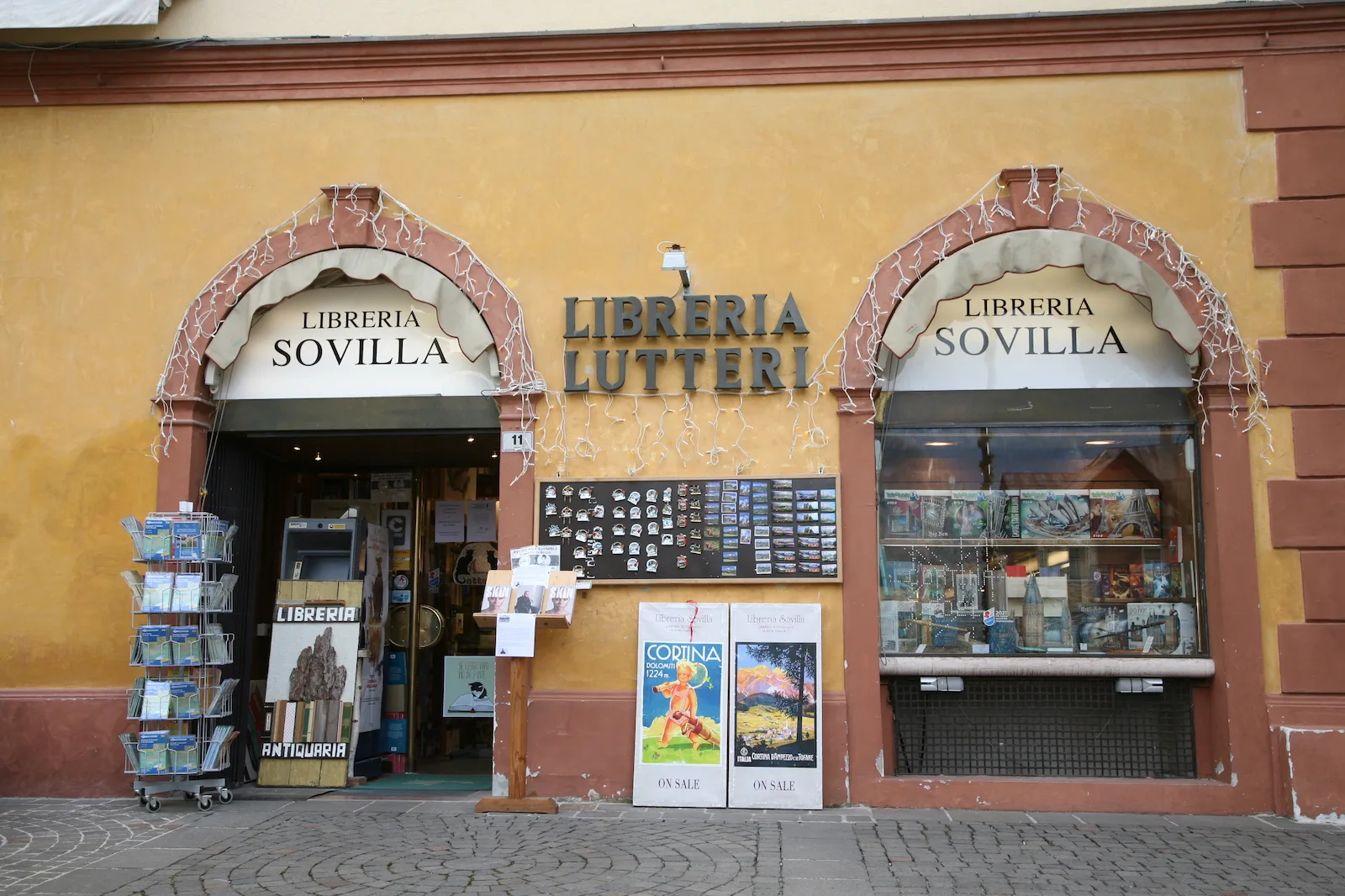
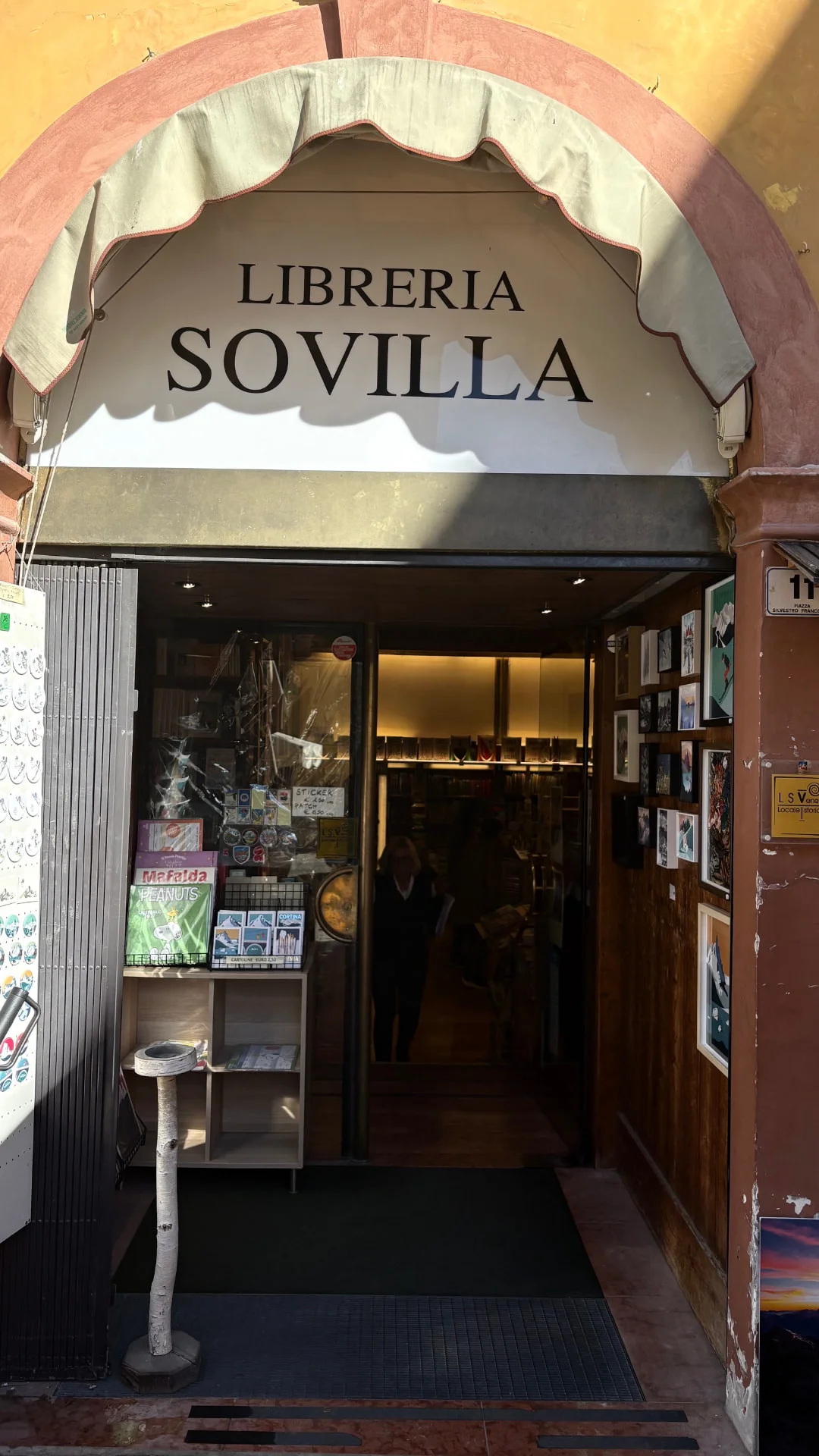
Libreria Sovilla is generally dated to 1971, but the shop's history goes back considerably further. A bookshop was established in Cortina by the Lutteri family in the early twentieth century, later passing to the Dreher Fois family, and in 1971 it came into the hands of Ilario Sovilla and his wife Giovanna. The premises moved about the town once or twice in the early years before settling where they are now.
The couple were already experienced booksellers by then. They had begun in 1951 with a small stall they set out every morning in Venice, and opened their first bookshop in Mestre the following year. Moving to Cortina was another chapter in a business they had built together rather than the beginning of it. More than fifty years later the shop remains in family hands, run by their son Franco and by Nicoletta, working alongside longstanding colleagues Sandra and Mirta and one of the family's daughters, Alice. In 2023 the business received official recognition as a locale storico, acknowledging its place in the region's commercial and cultural history.
That continuity is particularly striking in Cortina. Corso Italia is known for its fashion boutiques, jewellers and galleries, and there is plenty to occupy anyone with money to spend. Sovilla belongs to an older tradition of independent retail, where the attraction is the knowledge behind the counter and the judgement shown on the shelves. The shop has changed over the decades, but its purpose has remained remarkably consistent.
What Ilario Started
The most interesting part of Sovilla's history is what happened after the family arrived. Working with Leonardo Mondadori, Ilario Sovilla began organising public literary encounters, inviting writers and prominent figures to Cortina to discuss their books and ideas. Author appearances are now routine in bookshops and at festivals everywhere, but they were much less familiar in Italy at the time. In 1972 the idea grew into a month of books, initially with Mondadori alone, which filled Cortina's August with writers and with audiences that got larger every year.
The meetings became a fixture of Cortina's cultural calendar and eventually extended to the Grand Hotel Savoia, where the incontri letterari drew writers, politicians, critics, journalists and people from film, among them Indro Montanelli, Giovanni Spadolini, Riccardo Bacchelli and Corrado Augias. It is tempting to call Sovilla the birthplace of the Italian author talk, and the family's contribution was certainly pioneering, with Augias himself acknowledging the importance of those early encounters. Establishing that nobody elsewhere in Italy had organised anything similar would be a much larger historical claim than the record supports. What is clear is that a family bookseller helped make literary discussion part of the identity of a town already internationally famous for skiing, hotels and fashionable visitors.
That tradition has continued in different forms, and the shop's own history describes the encounters as carrying on under different management. Since 2009 Cortina has hosted Una Montagna di Libri, a literary festival with summer and winter programmes, which held its thirty-fourth edition in summer 2026 and brought writers and journalists from around the world into the Dolomites. The modern festival is a separate organisation rather than an uninterrupted continuation of Ilario's original meetings, but the connection in spirit is obvious, and some festival events still begin at the shop door. For a business of this size, it is an impressive cultural legacy.
What Is on the Shelves
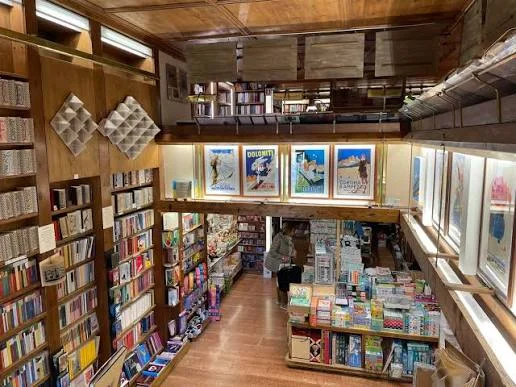
The selection is particularly strong in art, architecture, interiors and photography. There are substantial illustrated volumes, specialist publications and the kind of books that invite you to take them down simply to see what is inside. Mountain publishing is another strength, as you would expect in Cortina, although the range goes well beyond walking guides to take in local history, Alpine culture and the development of the Dolomites themselves.
There is also an entire section devoted to the First World War, which feels especially relevant here. Between 1915 and 1918 these mountains were part of the front between Italy and Austria-Hungary, and the military roads, tunnels and fortifications left behind are still visible in the landscape. The books give those places a history beyond their appearance on a walking map.
The rare and fine editions are worth exploring, and we spent much of our visit looking through them alongside the larger art and photography books. They are not the easiest things to travel with, particularly with limited luggage space, but they are precisely the sort of stock that makes an independent bookshop worth crossing a town for. Sovilla also carries fiction and non-fiction, and for the past decade or so has given real prominence to children's publishing and a careful selection of creative games. The shop has long made room for painting and photography exhibitions as well, reinforcing its role as something more than a retail business.
Browsing, Not Buying
We bought nothing, which felt like the wrong outcome and was entirely our own fault for travelling with hand luggage. What we did instead was stay a long time, work through the editions and ask questions about the shop's history. The answers were generous, and the staff spoke excellent English. At no point was there any suggestion that we were taking up space simply because we were not obviously about to buy something.
That matters in a shop holding specialist and potentially expensive stock. It would be easy to make the rare editions feel like a private collection rather than a selection for sale, or to treat browsers as a distraction from serious customers. Sovilla did neither. We were free to look, to ask and to enjoy the books, and it was a very pleasant way to spend part of an afternoon. The welcome is one of the strongest reasons to recommend the place, and the only regret was leaving without a book. Next time we will allow more room in the luggage.
Why It Earns Its Place
Cortina has no shortage of expensive shops, but relatively few have a history as distinctive as this one. Its shelves reflect the interests of the town and the mountains around it, and the family has played a part in the cultural life of the valley for more than half a century.
The shop is particularly rewarding if you are interested in photography, architecture, art or Alpine history, and you can arrive looking for one subject and find yourself drawn into several others. It is not a vast general bookshop, and the specialist selection will appeal more to some readers than to others, but that is also what makes it interesting. The stock has been chosen with a clear sense of identity, and the people working there know it well. We left empty-handed and not at all disappointed. There are very few shops where browsing alone feels quite this worthwhile.
The Lifestyle Edit Scorecard
- Stock & Specialism
- 9.3 / 10
- Character & History
- 9.5 / 10
- Welcome
- 9.4 / 10
- Breadth of Range
- 8.6 / 10
Who it's for
- Anyone interested in art, architecture, photography, mountain writing or the history of the Dolomites. Collectors and readers looking for unusual illustrated editions should allow time to explore the specialist stock. It is also worth visiting simply because you enjoy independent bookshops and talking to people who know their books.
- Less suited to visitors looking primarily for a large selection of English-language holiday fiction, or for a conventional high-street bookshop.
Questions
- Where is Libreria Sovilla?
- Piazza Franceschi 11, in the centre of Cortina d'Ampezzo, just off Corso Italia.
- How old is the bookshop?
- Its origins go back to the early twentieth century, when the Lutteri family established a bookshop in Cortina. It later passed to the Dreher Fois family, and the Sovilla family took over in 1971.
- Who runs it?
- Franco and Nicoletta Sovilla, with longstanding colleagues Sandra and Mirta and one of the family's daughters, Alice. Franco's parents, Ilario and Giovanna Sovilla, acquired the Cortina business in 1971.
- What does it specialise in?
- Art, architecture, interiors, photography, mountain publishing, local history and the First World War. It also carries rare and fine editions, fiction, non-fiction, children's books and creative games.
- Did Libreria Sovilla invent Italian author talks?
- The family helped pioneer public literary encounters in Cortina from 1971, working with Leonardo Mondadori, and from 1972 ran a month of books each August. The events attracted major Italian cultural figures and were influential, although a claim that they were the first anywhere in Italy cannot be established conclusively.
- What is Una Montagna di Libri?
- A Cortina literary festival established in 2009, with separate summer and winter programmes. Its thirty-fourth edition took place in summer 2026.
- Is the shop officially recognised as historic?
- Yes. It was recognised as a locale storico in 2023, after more than fifty years under the Sovilla family.
- Does the shop sell rare books?
- Yes. Rare and fine editions are among its specialisms.
- Do the staff speak English?
- Yes. During our visit the staff spoke excellent English and were happy to answer questions about the shop and its history.
- Is it worth visiting if I am not buying anything?
- Yes. We spent a long time browsing without making a purchase and were made entirely welcome.