Place
El Brite de Larieto, Where the Stable Is Part of the Restaurant
A working farm at 1,664 metres in a larch wood above Cortina, where the cows are twenty paces from the table and much of what reaches the plate was produced within sight of it. We ate outside on a gold October afternoon.
By James B. Stoney, Editor · 25 November 2026
A Farm That Happens to Serve Lunch
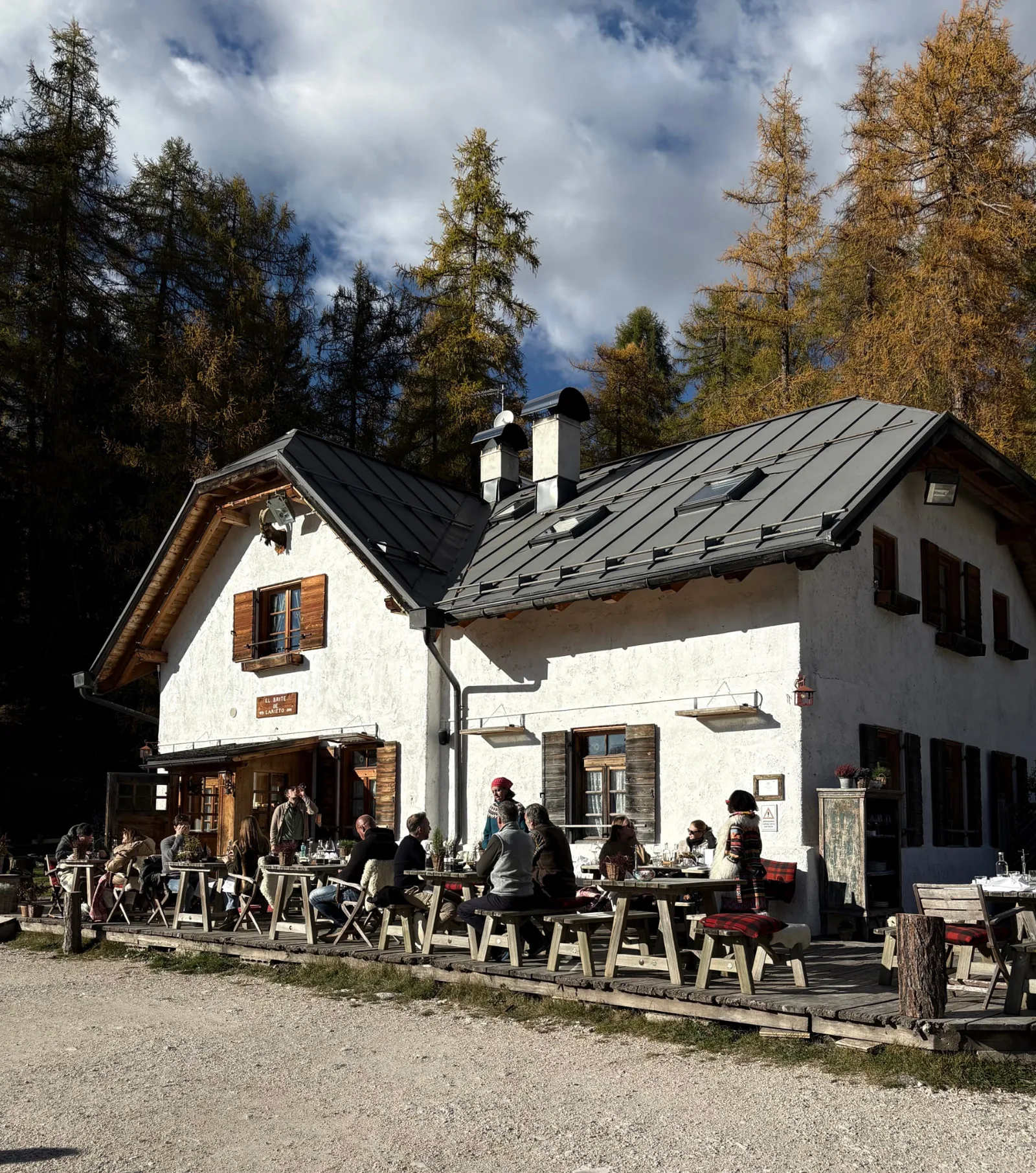
The name tells you what the place was. El Brite is Ladin for the shepherd's house, a malga where fresh milk was sold, and that is exactly what stood here before the Gaspari family took the derelict building on and refurbished it in 2004. The restaurant sits at 1,664 metres in a clearing of larch on the slopes of Pomagagnon, reached by a road off the route to Passo Tre Croci that winds up through the trees, and the approach does a good deal of the work before you have eaten anything. The larches were full gold when we came, the high rock still had snow on it, and the whole thing looked less like a restaurant than like somewhere you had been lucky to stumble across.
The farm is not a theme. There is a stable immediately beside the dining room, and when we looked in there were cattle standing in the dark chewing, with a cluster of farm cats asleep in the sun across the yard and a tractor parked beyond. This was the first restaurant in Cortina to have a working stable next door, which Riccardo Gaspari has said was inconceivable at the time, and it remains the thing that separates El Brite from every other mountain restaurant selling the idea of the mountains back to you.
The division of labour within the family is similarly literal. Riccardo's father Flavio has spent more than twenty years growing the vegetables, roots and wild herbs and raising the cows, goats and pigs. The milk becomes butter, yoghurt and cheese. By Riccardo's own account the farm supplies the meat and most of the ingredients used across the family's restaurants, which is a circularity most kitchens can only talk about.
There are three businesses in all, and they are worth understanding as a set. El Brite de Larieto is the original, up here in the wood, and it is where Riccardo started cooking. SanBrite, at Località Alverà by the lower entrance to Cortina, is the formal one: a former hay barn and garage converted into a restaurant that now holds a Michelin star and a Michelin green star, the second awarded for sustainability, which given what is standing in the stable up here is the obvious honour for this family to hold. Its name continues the joke, since san means healthy in the local Ladin, so the shepherd's house up the mountain has a healthy shepherd's house down in the valley. The third is Piccolo Brite, the dairy, built into SanBrite both operationally and architecturally, with a cellar where Riccardo ages the salumi and cheeses.
El Brite itself is listed in the Michelin Guide without a star, where the inspectors mark it as a favourite. That reads less as a lesser honour than as a different ambition. The starred cooking is down the valley. Up here the point is the farm.
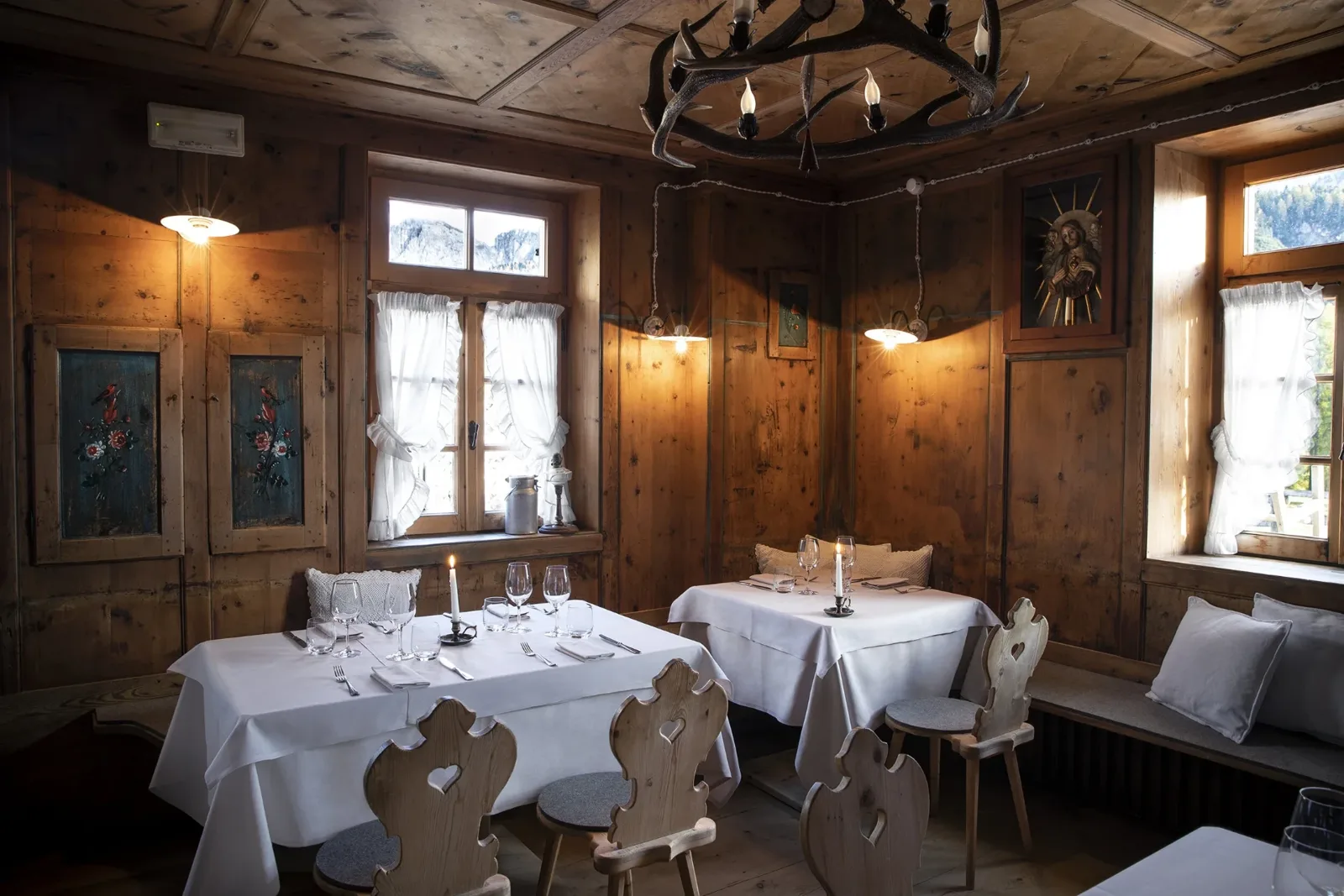
Inside, the oldest room is a fifteenth-century stube, with a newer and equally pleasant room on the upper floor. We did not sit in either.
What Arrives First
Bread comes first, and then the butter, and the butter is the thing people talk about. It arrives whipped into a pale yellow mass heaped well above the rim of a small wooden tub, carried out at shoulder height, absurd and completely serious at the same time. It is the family's own, made from the milk of the cows in the stable, and it tastes of something. Most restaurant butter is a formality. This is the argument the whole place is making, delivered before you have ordered.
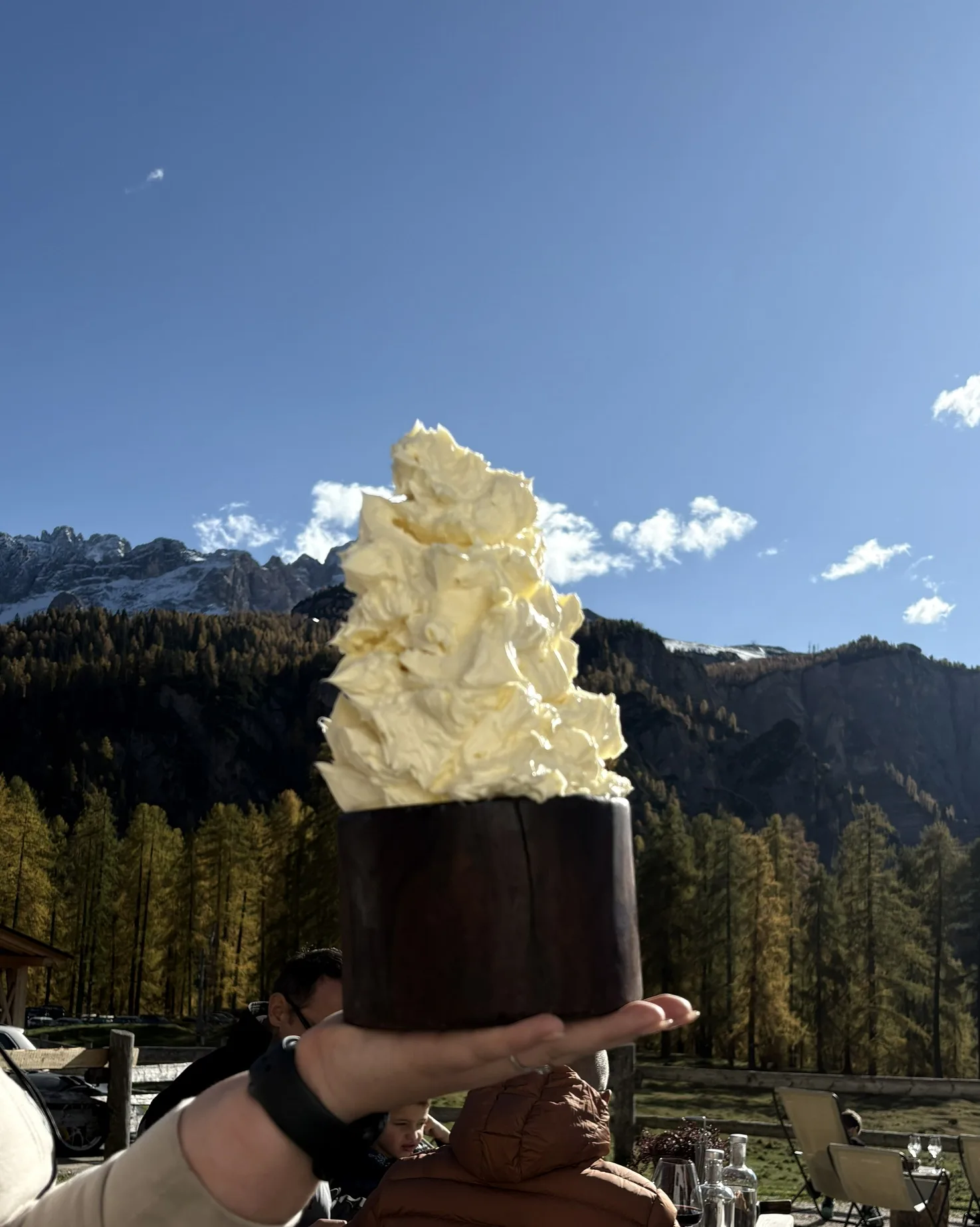
The bread itself is made in house, and the menu is candid about how it is served: two rounds come freely, and from the third there is a small charge. We had two and did not need a third, although the butter made the question a live one. It is a sensible piece of honesty from a kitchen where the bread is not a filler, and rather better than the common alternative of simply never refilling the basket.
The menu is short and holds its shape: four starters, four first courses, four second courses, with some dishes rotating through the season and others permanent. That brevity is a mark of confidence. There is nowhere to hide on a list of twelve things when so much of it came off your own land.
The Meal
We started with the meat tartare, hand cut rather than minced, dressed lightly with chives, shallot and whole mustard seeds, and served plain on a white plate with nothing arranged around it. It was excellent, and it was the clearest possible statement about the quality of the beef, because a tartare presented this bare has no technique to fall back on.
The cheesy polenta with mushrooms came in a small cast iron pot set on a crocheted mat, soft rather than set, with a slow-cooked egg collapsing into the middle of it and chives and black pepper across the top. It is the kind of dish that sounds rustic on a menu and turns out to have been made with real care, the polenta loose and rich and the egg folding through it as you eat.
Then the Soreghina gnocchi, which are the house signature and have been for years. They are potato gnocchi filled with cheese, arriving under a foam of Latteria Stravecchio, and the texture is the point: light where a stuffed gnocchio has every reason to be heavy, with the cheese inside and the aged cheese on top meeting somewhere in the middle. If you order one thing here, order these.
The tagliatelle with sausage ragù is the other fixture on the menu, and the two make an interesting pair. The gnocchi are the kitchen showing what it can do with milk, which is the ingredient this whole place is built on. The tagliatelle is the other half of the farm, the pigs rather than the cows, and it is cooked without any attempt at refinement: good pasta, a ragù with real depth, the kind of thing a farm would make for itself on a Sunday. Ordering both tells you more about the Gasparis than either does alone.
Eating Outside
We sat on the terrace, a run of wooden tables and trestle stools along the front of the white farmhouse, with sheepskins and tartan blankets left out on the seats for when the sun moves off. In October that is the place to be. The air is cold in the shade and warm in the light, the larches are turning, and Pomagagnon rises directly behind the building.
The restaurant was full while we were there and never felt crowded, which is a harder trick than it sounds and says something about how the room and the terrace have been laid out. Service was friendly and quick throughout, with no formality to it. Food arrives when it is ready and nobody makes a performance of anything.
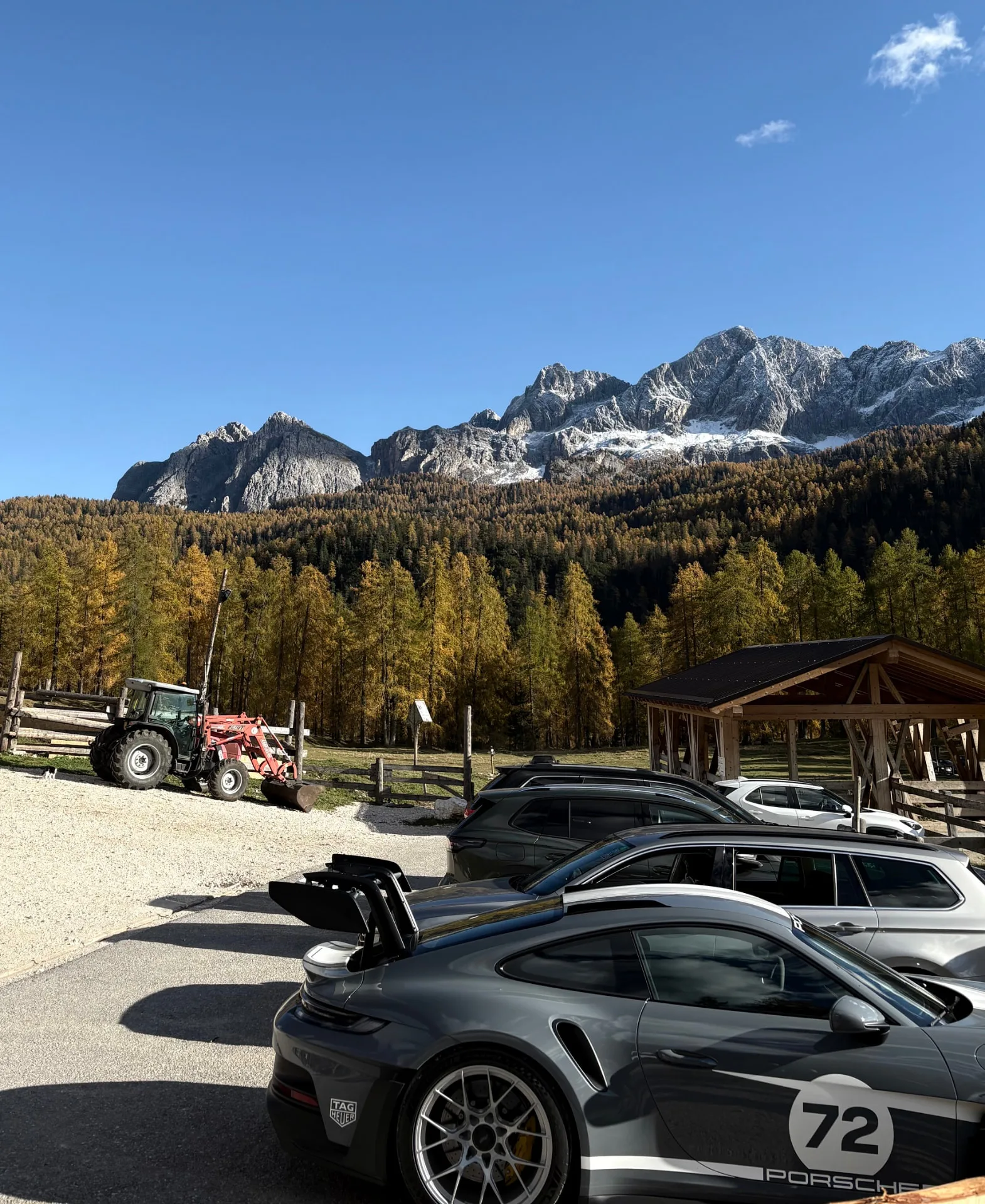
One observation that says a lot about Cortina. The car park is gravel, bounded by a wooden fence, with a tractor and muck spreader at one end. At the other end, when we were there, sat a Porsche GT3 RS in full racing livery alongside a row of large German estates. That is the valley in a single frame: a working farm that happens to be where everybody wants to have lunch.
Why It Earns Its Place
Plenty of restaurants in the Alps talk about provenance. Very few can point out of the window at it. The milk in the butter and the cheese in the gnocchi came from the animals in the stable twenty paces away, and the family grows and rears most of what the kitchen uses. That is not a marketing position here, it is simply how the business has always worked, and it was working this way long before the rest of the industry found the vocabulary for it.
What holds it fractionally short of the top is the sense that El Brite is now carrying a great deal of expectation on a site that was never designed for it. The cooking is unimpeachable and the hospitality holds up even at capacity, but a farmhouse kitchen in a clearing has a natural ceiling, and the Soreghina gnocchi are good enough to make you wonder what this kitchen could do with more room. Book well ahead and it is one of the most enjoyable lunches in the Dolomites.
The Lifestyle Edit Scorecard
- Food
- 9.5 / 10
- Setting
- 9.7 / 10
- Service & Atmosphere
- 9.4 / 10
- Value
- 9.1 / 10
Who it's for
- Anyone who wants to eat genuinely local food in the Dolomites without the apparatus of a tasting menu. It suits walkers, families, long lunches and anybody curious about where their food came from, since much of the answer is standing in the building next door.
- Less suited to those wanting a formal dining room. For the more composed version of the same family's cooking, SanBrite sits at the lower entrance to Cortina and carries the star.
Questions
- Where is El Brite de Larieto?
- Località Larieto, off the road to Passo Tre Croci above Cortina d'Ampezzo, at 1,664 metres in a larch wood on the slopes of Pomagagnon.
- What does the name mean?
- El Brite is Ladin for the shepherd's house, a malga where fresh milk was sold. The building was exactly that before the Gaspari family restored it.
- Who runs it?
- The Gaspari family. Riccardo Gaspari directs the kitchen and his father Flavio runs the farm. The family also owns SanBrite and the Piccolo Brite dairy.
- Does it have a Michelin star?
- No. El Brite is listed in the Michelin Guide and marked as an inspectors' favourite. SanBrite, the family's other restaurant, holds a Michelin star and a Michelin green star.
- What is SanBrite?
- The Gasparis' second restaurant, at Località Alverà by the lower entrance to Cortina. It occupies a converted hay barn, holds a Michelin star and a green star, and is the formal counterpart to El Brite. The family's dairy, Piccolo Brite, is built into it.
- What should I order?
- The Soreghina gnocchi, potato gnocchi stuffed with cheese under a Latteria Stravecchio foam, are the house signature. The whipped butter that arrives with the bread is worth the trip on its own.
- Is the bread included?
- Two rounds of the house bread are served freely, with a small charge from the third onwards. It comes with the family's own whipped butter.
- Is there really a stable next to the restaurant?
- Yes. The cattle are housed immediately beside the dining room. It was the first restaurant in Cortina to have one.
- Can you eat outside?
- Yes, on a terrace of wooden tables along the front of the farmhouse, with sheepskins and blankets provided. On a clear autumn day it is the best seat in the valley.
- What is the dining room like?
- The oldest room inside is a fifteenth-century stube, with a second room on the upper floor.
- Do you need to book?
- Yes. It is extremely popular and does large numbers in season. Book well ahead.
- How do you get there?
- By car, on a road that climbs off the Passo Tre Croci route through the larch wood. There is a gravel car park at the farm.