Experience
Beer Quarry Caves — The Underground World That Built England
Two thousand years of quarrying created an extraordinary underground landscape near the village of Beer. The stone helped build England's cathedrals; the chambers went on to hide priests, smugglers and a wartime mushroom farm.
By James B. Stoney, Editor · 18 October 2026
The Cathedral Beneath the Hill
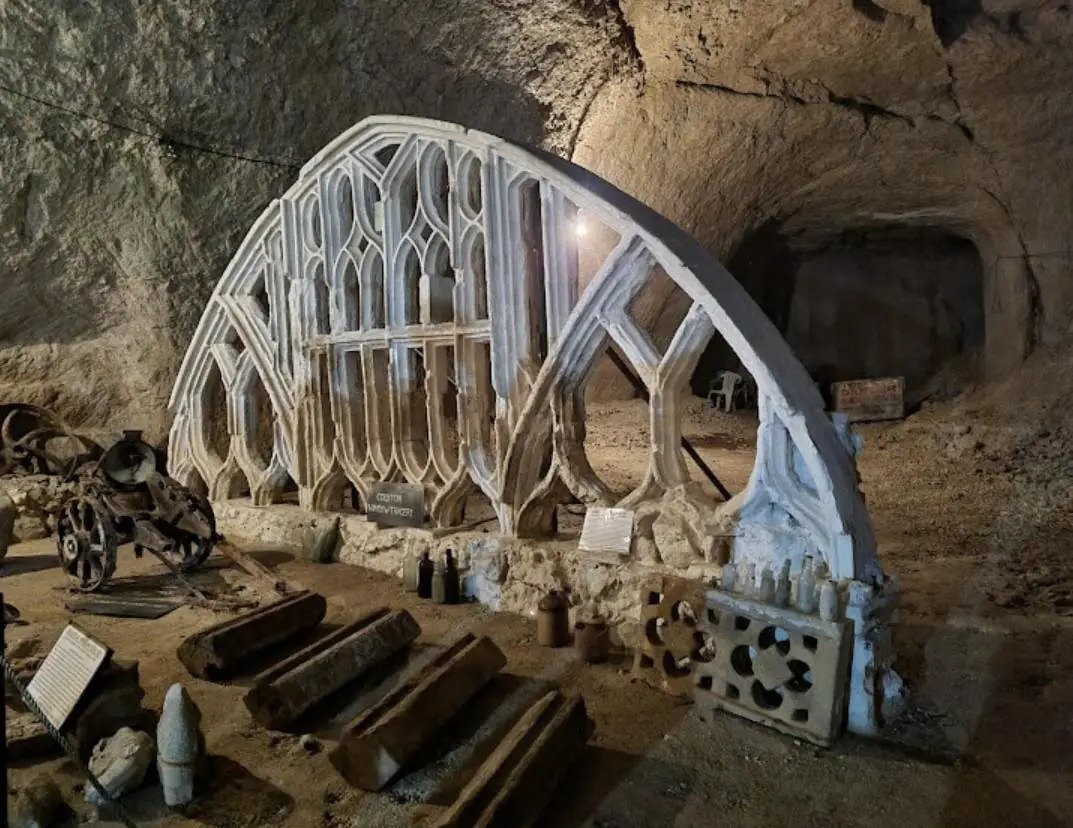
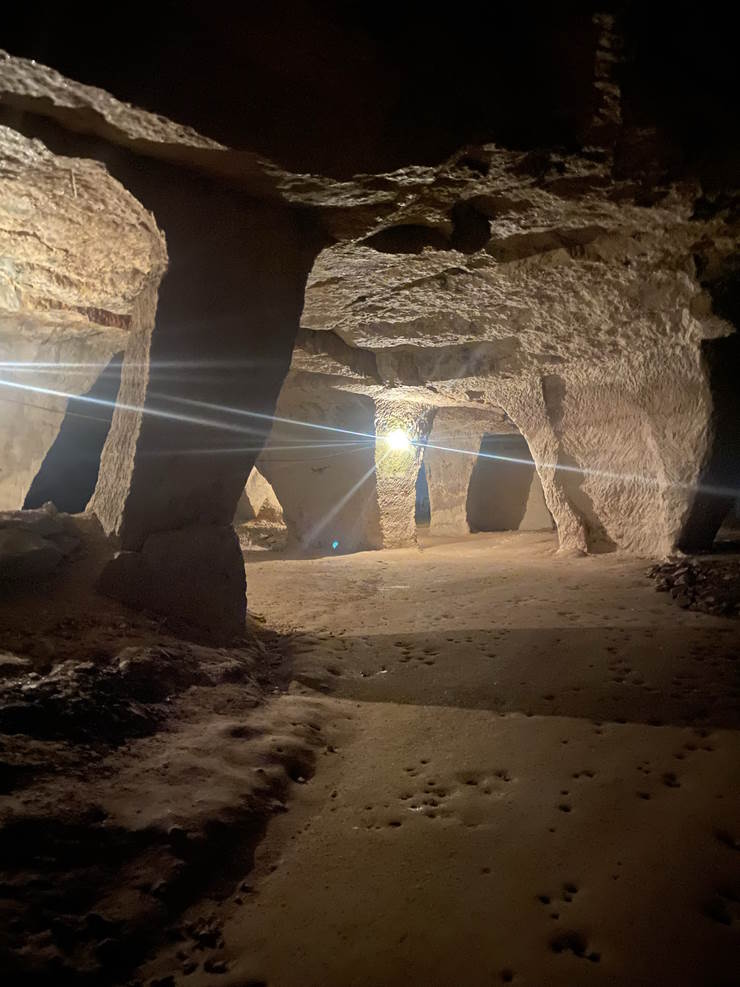
The most remarkable thing about Beer Quarry Caves is that they are not caves. The vaulted chambers, immense square pillars and connecting passages were cut by hand over roughly two thousand years, beginning with the Romans around 47 AD. What looks like a subterranean cathedral was a working quarry, and the resemblance is not accidental: this is where a great deal of the stone for the real ones came from.
Beer stone is a creamy-grey, fine-textured limestone from the Middle Cretaceous, and it has a particular virtue for masons. Freshly cut it is soft enough to carve in detail, hardening after exposure to the air. That made it the material of choice for the elaborate work that defines English Gothic — window tracery, vaulting, figurative carving. It went into Exeter Cathedral, Westminster Abbey, the Tower of London and Windsor Castle, and the operators count two dozen cathedrals in all. The earliest surviving use is closer to home, in the Roman villa at Honeyditches in Seaton.
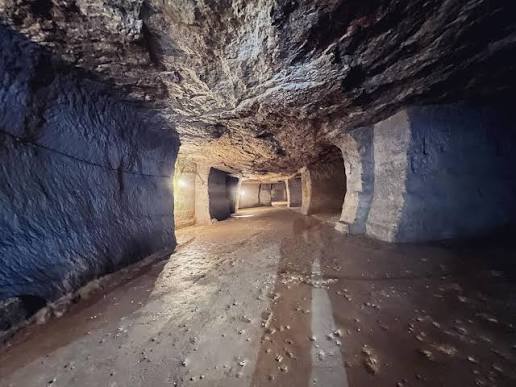
The workings grew outward and downward as each generation pushed further into the hillside, leaving substantial pillars standing to hold up the roof rather than clearing what came before. The result is an unbroken record of industrial method written into the stone, with Roman pick marks, medieval faces and Victorian working all visible in the same complex.
The People Who Cut the Stone
The guided tour is the only way in, and it is the right format, because the scale means very little without the labour that produced it. Men worked up to fourteen hours a day, two hundred feet below ground, by the light of candles they had to buy themselves out of their own wages. The tools barely changed for centuries. Blocks were hauled out and taken down to barges off Beer beach, then shipped along the coast to building sites hundreds of miles away.
The contrast with what the stone became is the point of visiting. Exeter Cathedral is admired for the skill of its medieval builders, and rightly. Beer is where you think about the men who were underground in the dark supplying them, whose names are not on anything.
It helps enormously that the guiding is good. An hour underground being walked through two thousand years of industrial method could go badly in the wrong hands, and it doesn't here — the detail is specific, the chronology stays clear, and the human story is kept in front of the stonework rather than behind it. Guided-only sites live or die on this, and it is the reason the hour passes quickly.
Quarrying here continued, on and off, into the twentieth century — with a surge during the Victorian fashion for church restoration — and stopped around 1920, when a new quarry opened opposite and made this one redundant. The chambers were left as they were, which is why they are still readable.
What Happened Next Underground
An abandoned quarry a mile from the sea turns out to be useful for a number of things. During the Reformation, the caves sheltered a secret Catholic chapel, with mass said underground out of sight of the authorities. Smugglers used the chambers to store contraband. In the Second World War, the complex held ammunition and was also given over to growing mushrooms to feed London.
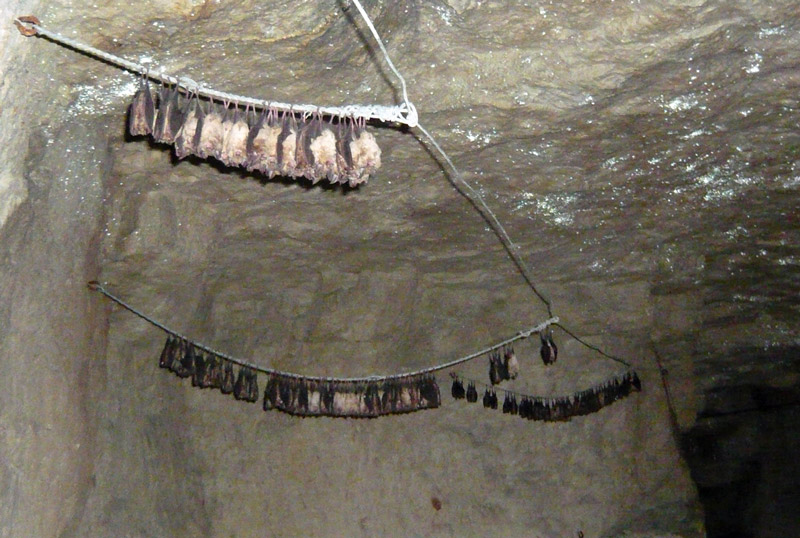
Then there are the bats. The site is a Special Area of Conservation and a Site of Special Scientific Interest, internationally significant as a winter hibernaculum for Greater and Lesser Horseshoe bats and the rare Bechstein's — which is a large part of why the tour season ends with October and why a camera runs underground through the winter months when nobody else is down there.
The most recent chapter is on screen. Beer Quarry Caves stood in for underground Eternia in the 2026 Masters of the Universe, directed by Travis Knight for Amazon MGM and Mattel, alongside Wells Cathedral and Wookey Hole. In October 2026 the theatre company Four of Swords staged Orpheus down there by candlelight, which is about as apt a choice of myth as the venue allows.
None of this supersedes the quarry. It just confirms that a space cut for an entirely practical reason has ended up with an architectural presence of its own.
Why It Earns Its Place
Beer Quarry Caves offer more than the usual underground attraction, because the significance is relational: the interest lies in the connection between this hole in a Devon hillside and buildings people travel across the country to look at. The cathedrals are familiar. The labour and the material that made them possible are not.
The guided format gives that history a shape, the guiding is genuinely good, and the chambers have a presence that photographs flatten entirely.
The limitations are practical. It is cold underground year-round, the ground is uneven, the approach is steep, and there is no wandering off on your own. Anyone with mobility difficulties should ring ahead rather than turn up.
For anyone interested in architecture, industrial history, or the relationship between craft and construction, this is among the most distinctive things in East Devon.
The Lifestyle Edit Scorecard
- Heritage & Significance
- 9.7 / 10
- Setting & Architecture
- 9.6 / 10
- Experience & Interpretation
- 9.2 / 10
- Value & Accessibility
- 8.7 / 10
Who it's for
- Visitors interested in architecture, industrial history and unusual spaces, particularly anyone who enjoys understanding how historic buildings were actually built. Less suitable for those uncomfortable underground or with mobility difficulties.
Questions
- Where are Beer Quarry Caves?
- Quarry Lane, Beer, East Devon, EX12 3AS, about a mile west of the village. Parking is free.
- When are the caves open?
- From the week before Easter to 31 October. In October, tours run at 10.30am, 12.30pm and 2.30pm; in peak season they go hourly from 10.30am, with a later departure during school holidays. Booking ahead is advisable on 01297 680282.
- How long is the tour?
- About an hour. There is no independent access.
- Are the caves cold?
- Yes, and at a fairly constant temperature year-round. Warm clothing and sturdy footwear are sensible whatever the weather above ground.
- Who owns them?
- Clinton Devon Estates, leased to Beer Quarry Caves Ltd.
- Were the caves used in Masters of the Universe?
- Yes. They appear as underground Eternia in the 2026 film, which also shot at Wells Cathedral and Wookey Hole.
- Are there bats?
- Yes. The caves are an internationally important hibernation site for Greater and Lesser Horseshoe bats and the rare Bechstein's, which is one reason the visitor season closes at the end of October.
- Are the caves accessible?
- Access is limited by the underground terrain and the approach. Contact the caves before booking if you have mobility requirements.