Experience
Faro Old Town — The City Behind the Walls
Behind Faro's monumental gateway lies a compact Portuguese city shaped by Romans, Islamic rulers, medieval kings, an English invasion and a devastating earthquake. The best way to understand it is on foot.
By James B. Stoney, Editor · 25 October 2026
A City Most Visitors Pass Through
Faro is an unusual regional capital. It has an international airport, a university, working neighbourhoods and a historic centre, yet many visitors see little of it beyond the road heading west towards the resorts.
That is a mistake. The Romans knew Faro as Ossonoba, an important port and commercial settlement. Under Islamic rule it developed into a fortified town, before Afonso III captured it in 1249, and it received city status in 1540. What followed was repeated destruction. In 1596 English forces led by the Earl of Essex attacked and burned much of the town, carrying off the library of Bishop Jerónimo Osório to England. The earthquake of 1755 did the rest.
What survives is therefore a city rebuilt several times over. Medieval masonry stands alongside neoclassical architecture, Islamic structures remain embedded in later Portuguese construction, and almost all of it can be covered in a short walk.
The Walk: From the Marina to the Walls
Begin at Jardim Manuel Bívar, the public garden beside the marina, and walk towards the Arco da Vila, the monumental entrance to the Cidade Velha.
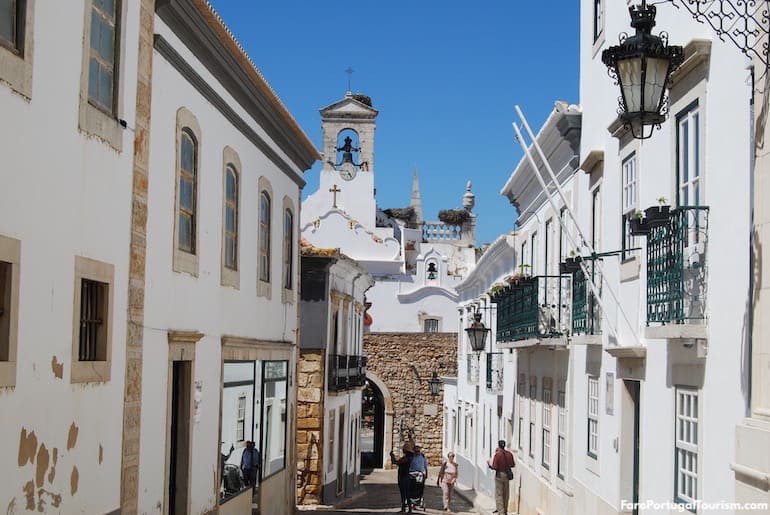
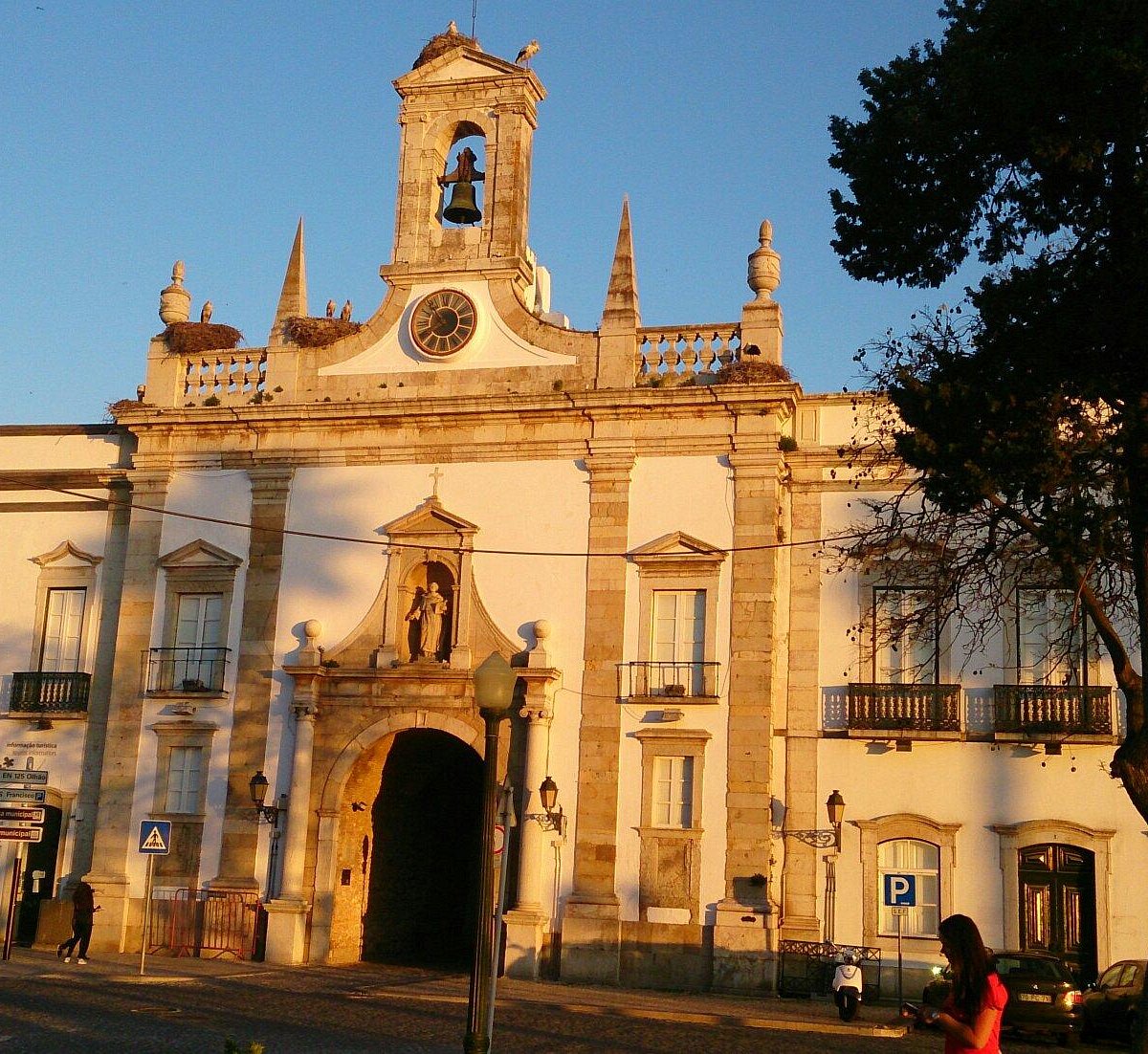
The gateway was designed by the Italian architect Francisco Xavier Fabri and inaugurated in 1812. Commissioned by Bishop Francisco Gomes de Avelar, it replaced a medieval entrance ruined by the earthquake, on a site whose origins reach back to the Roman city and its connection to the port.
Fabri, born Francesco Saverio Fabri near Bologna in 1761, did much of the work of rebuilding Faro after 1755. His gateway puts a formal neoclassical façade over considerably older fabric: inside the passage an Islamic horseshoe arch survives from the Moorish city, its stonework roughly a thousand years old. Above the entrance stands a statue of St Thomas Aquinas, with a small belfry and a permanently occupied stork's nest completing one of the city's most recognisable landmarks. It has been a National Monument since 1910.
It is an unusually honest entrance to a historic quarter — Roman foundations, Islamic construction and nineteenth-century architecture all occupying the same few metres.
Largo da Sé: One Architect's City
Pass through the arch and follow Rua do Município towards Largo da Sé, the principal square of the walled town.
The connection between the gate and the square is more than geographical. Fabri also designed the seminary that faces Largo da Sé, which makes this part of Faro a single reconstruction project rather than a collection of unrelated monuments. You are walking through one man's idea of what the city should look like after the earthquake.
The cathedral is much older. It was established after the Christian reconquest in the thirteenth century, on a site traditionally held to have been used for Islamic worship before that, and its present appearance reflects successive rebuildings — particularly after 1596. Gothic, Renaissance and Baroque elements sit together in the same building, and the tower gives views over the historic centre, the modern city and the Ria Formosa.
The square rewards lingering. Its buildings tell the story of somewhere that has adapted repeatedly to invasion, political change and natural disaster without losing its earlier character entirely.
Roman Faro and the Municipal Museum
A short walk brings you to the Municipal Museum, in the former Convent of Nossa Senhora da Assunção.
The museum was established in 1894, marking the 500th anniversary of the birth of Henry the Navigator. Its home is a Renaissance convent, classified as a National Monument in 1948, and its cloisters are among the finest things in the quarter. The building stands in the area associated with Faro's former Jewish quarter, which adds another layer to a city that has plenty.
Inside, the collections include Roman mosaics and archaeological material from Ossonoba, alongside objects from the Islamic and Portuguese periods. It is useful context for the streets outside: Faro is not a medieval town with handsome buildings, it is a site that successive communities have occupied for two thousand years.
The Other Gates
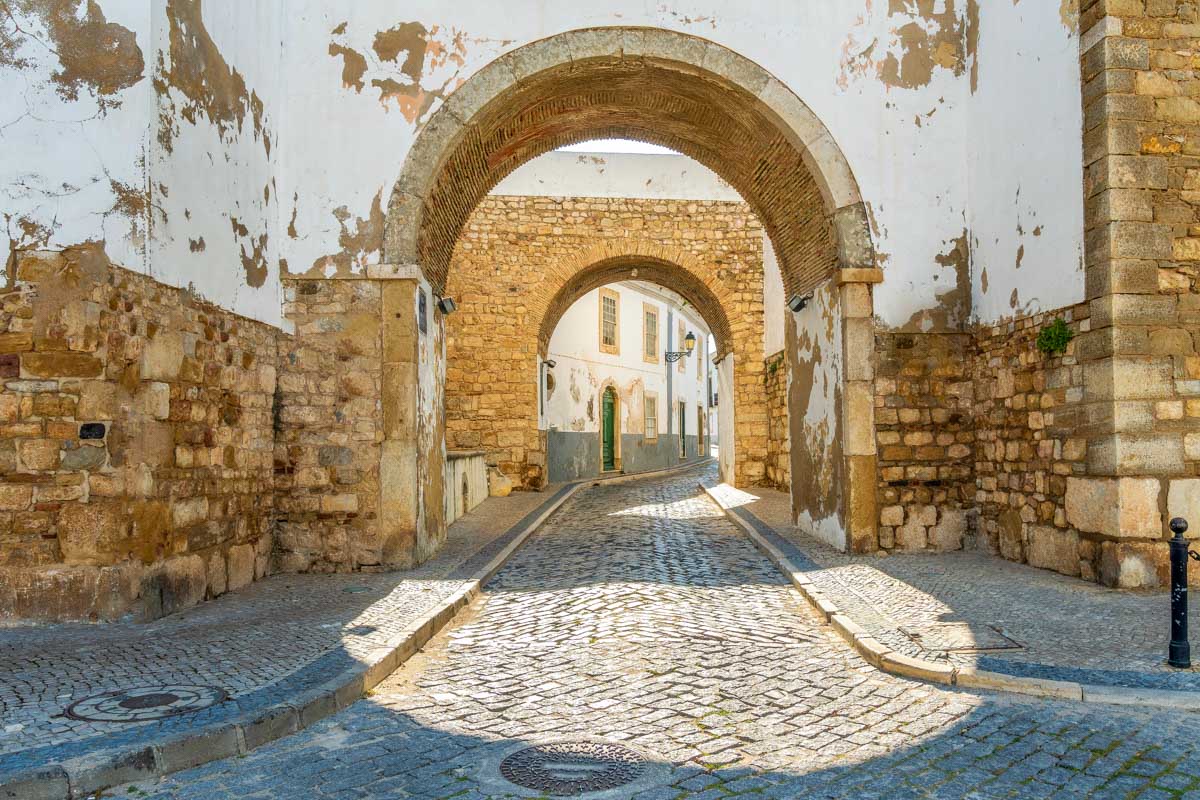
Continue towards the Arco do Repouso, another surviving entrance through the walls.
Local tradition holds that Afonso III rested here after taking the city in 1249, which is where the name comes from. The oldest sections of the fortifications around it are medieval improvements to the earlier Islamic defences, and unlike the ceremonial Arco da Vila this gate still looks like what it was. Its towers and masonry are a reminder that Faro was a fortified settlement controlling movement between the town, its hinterland and the water.
From here the quieter streets lead towards the Porta Nova, a smaller gateway opening onto the waterfront. The contrast is one of the pleasures of the walk: after the enclosed lanes and high walls, the view opens across the Ria Formosa and its channels, salt marshes and barrier islands.
Faro's relationship with the sea makes sense at that point. It is a coastal city whose maritime history has always run through a lagoon rather than a beach.
Why It Earns Its Place
Faro's old town is not a grand historic centre on the scale of Lisbon or Porto, and it would lose that comparison badly. Its appeal is compactness, and the unusually clear relationship between the different periods stacked on the same ground.
Within a short walk you encounter Roman archaeology, an Islamic gateway, medieval fortifications, a cathedral rebuilt across four centuries and the neoclassical reconstruction that followed the earthquake. The link between Fabri's arch and Largo da Sé is the most rewarding part, because it shows a city being reshaped as a whole rather than patched building by building.
There is also the character of the place. This is a working Portuguese city, not a quarter organised around visitors, and its streets and public buildings remain part of ordinary life. The walk earns its place because it reveals an Algarve that is easy to miss entirely: urban, layered and tied to the lagoon rather than the coast.
The Lifestyle Edit Scorecard
- History & Cultural Interest
- 9.5 / 10
- Setting & Character
- 9.3 / 10
- Experience & Enjoyment
- 9.2 / 10
- Value & Accessibility
- 8.8 / 10
Who it's for
- Anyone interested in Portuguese history, architecture, or exploring a city independently rather than being guided through it. Particularly good for visitors staying in Faro, and for anyone wanting an alternative to the Algarve's beaches and golf courses.
Questions
- Where should you start?
- At Jardim Manuel Bívar beside the marina, entering the walled quarter through the Arco da Vila.
- How long does it take?
- Around 75 to 90 minutes at a relaxed pace, or two to three hours if you go into the cathedral and the Municipal Museum.
- Is it free?
- Yes. The streets, squares, gateways and walls cost nothing. The cathedral and the museum charge separately.
- What are the main stops?
- The Arco da Vila and its Islamic gateway, Largo da Sé, the cathedral, the Municipal Museum, the Arco do Repouso and the Porta Nova.
- Can you climb the cathedral tower?
- Yes, for views over the city and the Ria Formosa.
- Can you go up the tower above the Arco da Vila?
- Access is via the tourist office below it.
- Is it suitable for visitors with limited mobility?
- Much of the quarter can be explored at ground level, but there is uneven paving, there are slopes and narrow passages, and the cathedral tower is reached by stairs.
- Is it worth the trip from Quinta do Lago?
- Yes. It is a short drive and an entirely different proposition — Portuguese urban life, history and architecture rather than managed resort landscape.